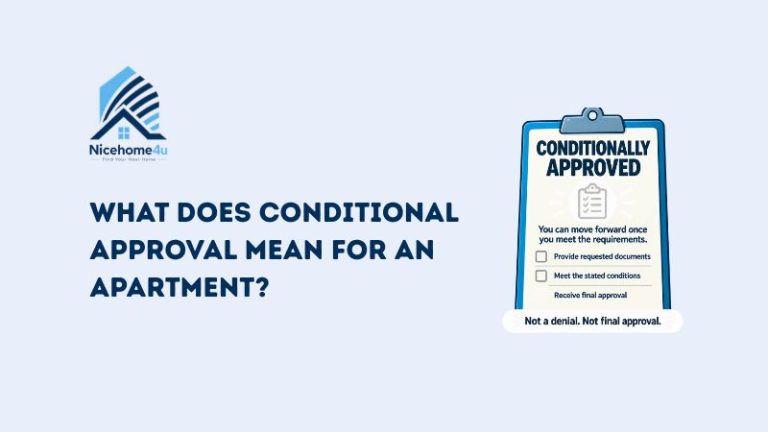
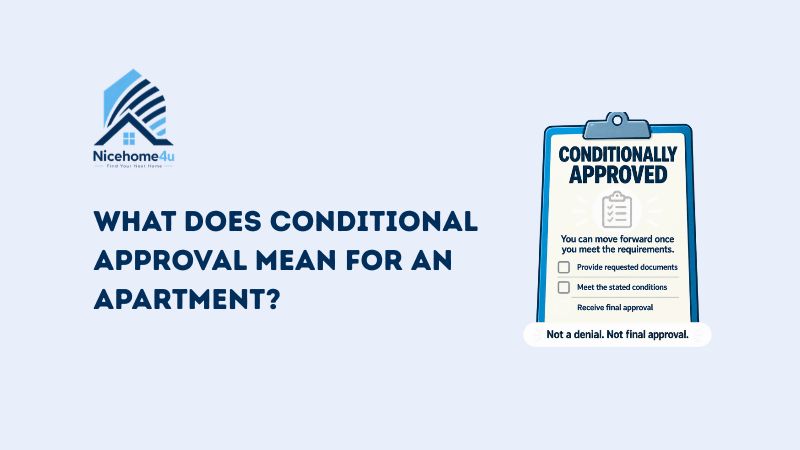
Seeing “conditionally approved” on your rental application can leave you unsure about your next move. What does conditional approval mean for an apartment? The landlord is willing to move forward if you meet a few requirements first.
If you have been conditionally approved for an apartment in Oklahoma, this guide explains why it happened, how to respond, and what to check before accepting the terms.
What Is Conditional Approval for a Rental?
Conditional approval means the landlord is willing to rent to you if you meet extra requirements first. It is not a denial and not a final yes. Common conditions include a bigger upfront payment, a cosigner, or more proof of income.
During the application process, the landlord checks your credit, income, employment, and rental history. If you almost meet the property’s rules, the landlord may add conditions instead of saying no. After you meet the conditions, the landlord reviews your documents and confirms whether your application is fully approved. You can then move forward with signing the lease.
You may see a conditionally approved rental application in an email, a portal message, or a call from the leasing office. The wording varies, so ask the landlord to list the conditions in writing. The notice is not a lease. Do not give notice at your current home or move until you have final approval.
This guide is about renting an apartment, not a home loan or a mortgage.
Is Conditional Approval the Same as Being Approved or Denied?
No. Approved means you can sign the lease as written. Denied means the landlord will not rent to you. Conditional approval sits in between: you get the apartment only after you meet the landlord’s conditions.
| Comparison point | Approved | Conditionally approved | Denied |
| Meaning | The landlord says yes | The landlord says yes, if you meet the conditions | The landlord says no |
| Next steps | Sign the lease and cover move-in costs | Meet the conditions by the deadline | Ask why, read the notice, and apply elsewhere |
| Additional requirements | None | Yes, such as a cosigner or extra proof of income | Not applicable |
| Other names | Final approval, or fully approved | Approved with conditions | Application declined |
Why Was I Conditionally Approved?
Landlords usually add conditions when your credit, income, or rental history falls just short of their rules. Once the landlord has reviewed your file, a small gap often leads to conditional approval.
The property owner’s goal is to reduce risk, not to turn you away. The conditional approval notice or the leasing office should tell you which area caused it.
1. Credit
During the screening process, a credit report may show late payments, collections, or a high amount of debt. Unpaid debt, even a small amount, can trigger conditions. Instead of a denial, the landlord may ask for a bigger upfront payment or a cosigner to balance the risk.
2. Income
Many landlords typically require income of about three times the monthly rent. If your income is a little under the rule, you may be conditionally approved with extra proof of income, such as more pay stubs or bank statements, or with a cosigner.
3. Rental history
A first-time renter, a short rental record, or an old unpaid balance can lead to conditional approval. The landlord may want a reference, a short explanation, or a larger upfront payment.
What Can an Oklahoma Landlord Ask for After Conditional Approval?
Common conditions include a higher security deposit, a co-signer or guarantor, extra proof of income, prepaid rent, extra references, or a short explanation letter. The landlord reviews your application, decides what conditions you need to meet, and lists them in the written approval.
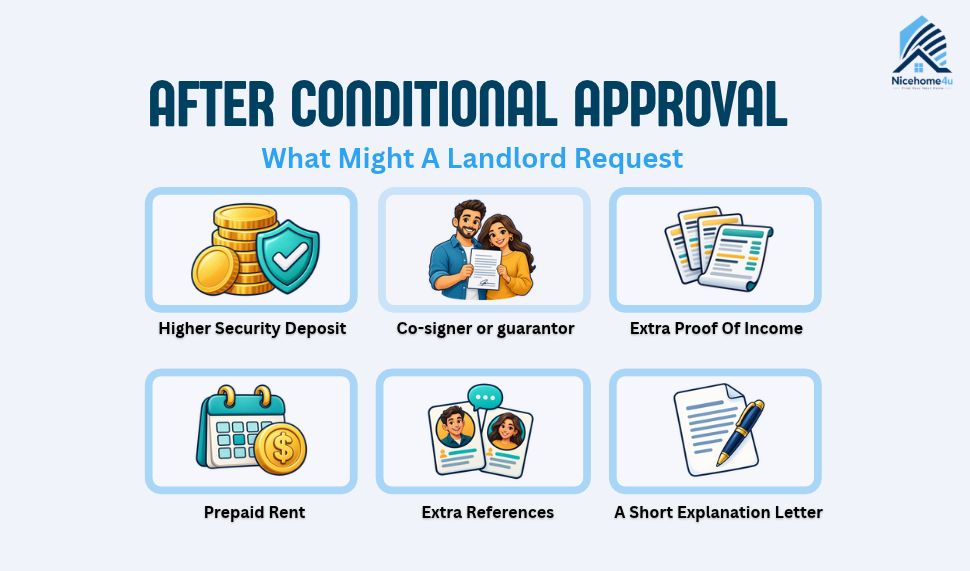
- A higher security deposit: often used when credit or rental history is the concern
- Extra proof of income: more pay stubs or bank statements, or tax returns if you are self-employed
- Prepaid rent: extra rent paid up front
- Extra references: a former landlord or an employer
- A short explanation letter: explains a gap or a past problem
- A cosigner or guarantor: often used when income or credit falls short
A higher deposit is one of the most common conditional approval apartment deposit requests, because it is easy for the landlord to apply. In Oklahoma, landlords must keep security deposits in an escrow account at a federally insured financial institution located in the state. Under 41 O.S. § 115, they must return any remaining deposit within 45 days after the tenancy ends, possession is returned, and the tenant makes a written demand.
Does Conditional Approval Raise My Rent or Only My Move-In Cost?
Usually only your move-in cost, not your rent. A condition like a bigger upfront payment or prepaid rent changes what you owe at move-in, not the monthly rent in the lease. Ask for the rent and every move-in charge in writing before you agree.
Here is a simple example of a conditional approval with placeholders, not real numbers:
- Normal deposit: $1,000
- Security deposit after conditional approval: $1,500
- Monthly rent: still $1,000
Compare the monthly rent in the conditional approval to the listing. If the landlord increases your rent based even partly on your credit report, they must give you an adverse action notice under federal law.
What Should I Do in the First 48 Hours?
Act fast. Read the notice, gather your documents, add up your move-in cost, and contact the leasing office. A short delay can cost you the apartment and your new rental.
- Read the notice. Look for the conditions, the deadline, and the name of any screening company. Keep the conditional approval email in case of a dispute.
- Gather your documents. Collect pay stubs, bank statements, a reference letter, or your cosigner’s details before the landlord asks.
- Add up your move-in cost. Include the first month’s rent, the deposit, fees, and any prepaid rent.
- Contact the leasing office. Use the questions below.
What Should I Ask the Leasing Office?
Ask five things about your conditional approval:
- What caused this conditional approval?
- Are there other options, such as a co-signer instead of a higher upfront payment?
- What is my deadline?
- What is my total move-in cost?
- Is the unit held for me while I complete the conditions for final approval?
What If I Have No Credit History or No Rental History?
Yes, you can still be approved. No credit history is different from bad credit: there is little to report, not something negative. Landlords mainly want proof you can pay rent, and the right documents can often back up a thin file.
Documents that help:
- A recent pay stub or an employment letter
- Bank statements showing regular deposits and savings
- A reference from a landlord or employer
- A cosigner who meets the property’s rules
If your concern is past credit problems, see our guide to renting with bad credit in Oklahoma.
Can I Negotiate Conditional Approval Requirements Before Accepting?
You can ask. Landlords often have more than one way to meet the same goal, such as a co-signer instead of a larger upfront payment. Whether to accept depends on what you can afford.
Before you accept the conditional approval, ask yourself:
- Can I pay this without risking rent next month?
- Will I still have emergency money, or will this use all my savings?
- Is this place worth the extra money?
- Would another landlord ask for the same thing?
Check how much money you will have left after paying your move-in costs, rent, and other bills. If the cost is too high, say so and ask for another option, even if the deadline is close.
How Long Do I Have to Meet the Conditions, and What If I Can’t?
The landlord usually sets the deadline, so get it in writing. If you cannot meet a condition, tell the landlord right away and ask for another option.
If the condition is a cosigner, contact that person today. They may need time to send their own documents.
Will the Landlord Send Me a Written Notice?
Often yes. If a credit or screening report played any part in the conditions, federal law may require an adverse action notice. It names the reporting company and explains your rights.
Under the Fair Credit Reporting Act, a landlord who requires a larger deposit, a cosigner, or higher rent based even partly on a consumer report must give you notice. The FTC says this applies even if the report was not the main reason. The FTC also says the notice can be oral, but written is best practice, so ask for it in writing.
The notice tells you which company supplied the report. You can request a free copy from that company within 60 days of receiving the notice. Check it for mistakes and dispute any inaccurate information with the reporting company.
Is Conditional Approval Legal, and What Are My Rights?
Yes, conditional approval is legal if the landlord applies it fairly and the same way to all applicants. The landlord cannot use conditions to discriminate based on protected characteristics.
The federal Fair Housing Act protects race, color, religion, sex, national origin, familial status, and disability. Oklahoma’s housing law (25 O.S. § 1452) also protects age. A landlord can set conditions for conditional approval based on credit, income, and rental history, but must apply them consistently. Fair treatment also means the same approval process and the same application process for every applicant.
If you think a condition was applied unfairly, save the messages and the written criteria. You can file a complaint with HUD, generally within one year, or contact the Oklahoma Attorney General’s Office of Civil Rights Enforcement.
Is This the Same as Conditional Loan Approval?
No. Conditional loan approval is a mortgage term where a lender gives loan approval for a home purchase subject to conditions. Apartment conditional approval is similar in idea, but it involves a landlord, a lease, and no loan.
A mortgage lender may ask for extra documents or an appraisal before it clears the loan. A rental has none of that. The landlord decides, and you move to final approval once you meet the conditions. For mortgage questions, talk to your lender.
Conclusion
Conditional approval gives you a chance to move forward, but you should be comfortable with the requirements before accepting. Make your decision based on the written offer, not the approval label alone.
At NiceHome4U, our team can explain a property’s requirements and help you understand which documents are needed. If you are unsure about a condition on your application, contact our team for guidance on your next step.