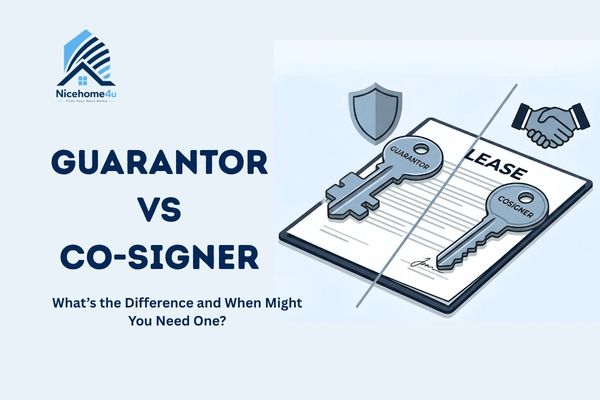
So you found an apartment you love. Good neighborhood. Fair rent. Then the landlord asks: “Do you have a co-signer or guarantor?”
Suddenly, your brain freezes.
Are those the same thing? Do you need both? Will your aunt have to move in with you?
Let me explain it like we’re sitting across a kitchen table. By the end of this, you’ll know exactly what is a cosigner, what is a guarantor, and which one actually solves your situation.
First Things First: What Is a Cosigner?
Let’s start with the most common question: what is a cosigner?
In plain English, a cosigner is someone who signs the lease right next to you. They are jumping into the pool with you. From the landlord’s perspective, you and the cosigner are a team.
If you don’t pay rent on Tuesday, the landlord can call the cosigner on Wednesday. No waiting period. No warning shot. The cosigner is legally responsible from Day One.
Think of a cosigner as: Your financial twin for the entire lease term.
Now, if you’re searching for what is a co-signer on a lease, the legal answer is this: a co-signer is a second applicant who guarantees rent payment and all lease obligations alongside the primary tenant. They share joint and several liability, a fancy legal term meaning the landlord can go after either one of you for the full amount.
Who Typically Acts as a Cosigner?
- A parent helping an adult child
- A roommate or partner moving in with you
- A family member who will live in the home
When Might You Need One?
You might need a cosigner on lease if:
- Your income alone doesn’t hit the 3x rent requirement
- Your credit history is thin or young
- You’re a first-time renter or student
So What Is a Guarantor?
Now for the backup player. What is a guarantor?
A guarantor is different. A guarantor stands behind you, not next to you. They sign a separate agreement (often called a “guaranty”) that says: “If this tenant completely fails to pay, I will step in.”
The landlord usually has to try to collect from you first, send you to collections, and file an eviction notice. Only when that fails do they knock on the guarantor’s door.
Think of a guarantor as: Your financial safety net. The “break glass in case of emergency” option.
So when we define what is a guarantor on a lease, here it is: a third-party financial backup who guarantees the lease without living in the property. They have no occupancy rights. They’re strictly there for financial assurance.
Who Typically Acts as a Guarantor?
- Parents of college students
- Adult children helping aging parents
- Relatives with strong income and credit who do not live with you
When Might You Need One?
A guarantor on lease is commonly used for:
- Students renting their first place
- Young professionals with low income history
- International renters without U.S. credit
- Self-employed or gig workers with irregular income
The Real Confusion: Guarantor vs. Cosigner
Here’s where most renters get tripped up. When people search for a guarantor on lease, they often actually mean cosigner. And when they search for a co-signer on a lease, they sometimes describe a guarantor.
Let me simplify it with a table you can actually remember:
| Feature | Cosigner | Guarantor |
| Who pays first? | Pays with you immediately | Pays only if you cannot |
| Do they live with you? | Usually yes (spouse, roommate) | Usually no (parent, aunt, uncle) |
| Credit impact? | Direct late payment hurts you both | Indirect only hurts them if you default |
| Income needed? | Combined with yours (3x rent total) | Much higher (4–5x rent alone) |
| Signs the lease? | Yes, as a co-tenant | No, signs a separate guarantee agreement |
That’s the core of guarantor vs cosigner in a nutshell.
Guarantor vs Cosigner: Which One Do You Need?
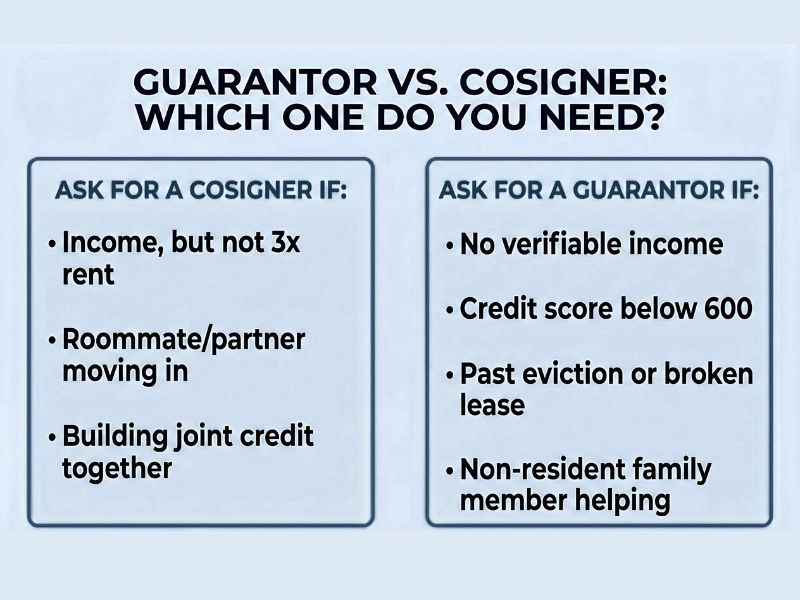
Here’s the million-dollar question in the guarantor vs cosigner debate.
Ask for a cosigner if:
- You have some income, just not enough to hit the 3x rent requirement alone
- You have a roommate or partner who is moving in with you
- You want to build credit together (on-time payments help you both)
Ask for a guarantor if:
- You have no verifiable income (students, new freelancers)
- Your credit score is below 600 ( Read our guide on renting with bad credit for more options)
- You have a prior eviction or broken lease on your record
- A relative wants to help you but will not be living with you
Breaking Down the Role of a Guarantor
Let’s get specific. You’re searching for a guarantor because your credit is thin or you’re a student or you just started freelancing.
Here is what a landlord looks for in a qualified guarantor:
- Strong credit score: 650 minimum. Honestly? 700 or higher makes me sleep better at night.
- Stable income: At least 4–5 times the monthly rent. Why so high? Because they have their own rent or mortgage to pay. They need to afford their life plus yours if things go south.
- U.S. residency: The guarantor must live in the United States. If they live overseas, good luck enforcing a contract.
- Clean financial history: No recent bankruptcies, no active judgments, no massive collections accounts.
Not everyone can be a guarantor. Your cousin who works part-time and has a 580 credit score? Probably not. Your aunt who owns a home, has a 720 score, and has worked at the same hospital for twelve years? Perfect.
What About a Cosigner?
If you’re looking for a cosigner, the rules are slightly looser but also more immediate.
A cosigner is typically:
- A parent helping their adult child get started
- A roommate who earns less than you but has great credit
- A partner moving in with you
The big catch with a cosigner? Joint and several liability. If your roommate/cosigner disappears to Bali, you owe the full rent. Not half. All of it.
Let Me Answer Your Burning Questions
“Can two people apply together to combine our income?”
Yes. If you’re moving in with a partner, roommate, or family member, both incomes can be combined to meet the 3x rent requirement. Each adult (18+) pays their application fee (usually around $50) and completes their own background check. Combining incomes opens up more homes to you. If you don’t qualify alone, applying with a co-applicant is often the fastest path to approval.
“Can I add someone to my lease after I move in?”
Yes, but you need to let your landlord know first. Adding an occupant requires updating the lease properly. Any new adult (18+) will need to go through the standard application process, background check, credit check, income verification to ensure they meet our rental criteria. This protects everyone. Never add someone without notifying your landlord. Unauthorized occupants can put your lease at risk. A quick call is all it takes to do it right.
“Does a guarantor have to live in the same state?”
Technically no, but practically yes. Most landlords prefer a guarantor who lives in the U.S. where courts have jurisdiction. A guarantor in Canada? Possibly. A guarantor in Poland? Very difficult to enforce.
“Can I be my own guarantor?”
No. That defeats the entire purpose. A guarantor is someone else who vouches for you.
“What happens if my cosigner misses a payment?”
It hits your credit report too. That’s the danger of a cosigner. You are financially married for the lease term.
What Makes a Strong Guarantor (From a Landlord’s Mouth)
I’m a property manager. I see guarantor applications every week. Here is what actually makes me approve one quickly:
- Credit score 650+ (700+ is better)
- Income 4–5x monthly rent (if rent is $1,000, they need $4,000–$5000 monthly)
- U.S. resident or citizen (legal enforceability matters)
- Age 18+ with stable employment history
- Clean financial record (no recent bankruptcy, no active judgments, no major collections)
If your potential guarantor has these things? I will approve them all day long.
Common Mistakes Tenants Make
Understanding what a cosigner is and what a guarantor is isn’t enough. Tenants often make these mistakes:
- Assuming a co-signer is “just support.” A co-signer is fully liable, not just a reference.
- Choosing someone financially weak. A guarantor must be stronger than the tenant, not equal or weaker.
- Adding someone informally. You cannot “just add” a co-signer or occupant without approval.
- Not understanding lease liability. Both roles can result in collections or legal action if rent is unpaid.
Why Landlords Use These Options
From a property management perspective, co-signers and guarantors help:
- Reduce rental risk
- Increase approval flexibility
- Expand access to tenants who are otherwise qualified but financially borderline
- Maintain rent collection stability
It’s a balance between opportunity and financial security.
How Nicehome4u Handles Co-Signers and Guarantors
At Nicehome4u, we are a tenant-first rental platform serving the Oklahoma City metro. That means we don’t play games with fine print. We want you to get into a home you love, but we also want you to understand exactly what you’re signing.
Here is our real-world policy:
Do you allow co-signers if my income doesn’t fully qualify?
Yes, but on a case-by-case basis. If your income alone doesn’t meet our 3x rent requirement, a co-signer with qualifying income may be able to help bridge the gap. The co-signer would need to complete their own application, background check, and income verification. They take on legal responsibility for the lease alongside you.
My advice? Contact us before applying to discuss whether a co-signer makes sense for your situation. We’ll be straight with you about what’s possible. No runaround.
Who can be a guarantor for a Nicehome4u property?
We are selective because your home matters. A strong guarantor must have:
- A credit score of 650 or higher (700 preferred)
- Stable income at 4–5x the monthly rent
- U.S. residency (for legal enforcement)
- No recent bankruptcies or active judgments
- Clean rental history
Adding someone after move-in? Yes, but you must notify us first. Any new adult occupant (18+) goes through the standard application process. This protects you, protects us, and makes sure everyone is officially covered. Unauthorized occupants put your lease at risk so just make that quick call.
Combining incomes with a roommate? Absolutely. Both incomes count toward the 3x rent requirement. Each adult pays the $50 application fee and completes their own background and rental history check.
Final Summary
Let me leave you with this:
- A cosigner shares the lease and often lives with you. They are your financial twin.
- A guarantor backs your lease financially but does not live with you. They are your safety net.
- Both reduce risk for landlords and improve approval chances.
- Both carry serious legal and financial responsibility.
Understanding what is a guarantor, what is a cosigner, and the difference in guarantor vs cosigner helps you make smarter rental decisions and avoid lease complications later.
The bottom line? Whether you need a cosigner or a guarantor, Nicehome4u will give you a clear, honest answer. No hidden tricks. No confusing legalese. Just help finding a rental home that works for your actual life.
Ready to find your next home? Browse houses for rent across the OKC metro; we’ll work with your situation.