

Yes, a landlord may deny an emotional support animal request in certain circumstances. However, whether the denial is lawful depends on the housing protections that apply and the specific facts of the request. A no-pet policy or lease restriction does not automatically settle the question where an applicable law requires a reasonable accommodation.
If your landlord has rejected your request or has not given you a clear answer, you may be unsure how to respond. This guide explains how to recognize an actual denial, understand the landlord’s reasons, and consider your next steps. It also covers what you can do if your landlord delays a decision.
TL;DR:
- A request for additional information does not necessarily mean your landlord has denied your ESA.
- A landlord’s stated reason for refusing an ESA should be considered under the housing laws that apply.
- Tenants may have options for challenging an improper denial or unreasonable delay.
Has Your Landlord Actually Denied Your ESA Request?
A landlord asking questions about your emotional support animal does not necessarily mean your request has been denied. A denial means the landlord has refused the requested accommodation, while a request for clarification indicates that the decision may still be under review.
For example, if your landlord says the animal cannot live in the property, that is a clear refusal. If the landlord says the decision is pending, ask what information or issue remains unresolved. If you are unsure whether the landlord has made a final decision, ask for clarification.
What Did HUD’s 2026 Policy Change for Emotional Support Animals?
Whether a landlord can reject an emotional support animal (ESA) request depends on the applicable housing protections and the circumstances of the request. A recent change to the U.S. Department of Housing and Urban Development’s (HUD) enforcement policy has also affected how certain ESA complaints are handled.
How Does HUD’s 2026 Policy Affect Emotional Support Animals?
On May 22, 2026, HUD changed how its Office of Fair Housing and Equal Opportunity (FHEO) handles complaints involving assistance animals. Under its new enforcement guidance, FHEO will find reasonable cause and recommend charges only in cases involving animals trained to provide disability-related assistance. The memorandum further explains that the animal must be individually trained to perform work or tasks directly related to the person’s disability. This significantly changes the federal administrative enforcement approach for untrained emotional support animals.
However, the policy does not amend the Fair Housing Act or eliminate the possibility of private lawsuits. The memorandum also does not address how HUD will process complaints involving housing providers covered by Section 504 of the Rehabilitation Act or the Americans with Disabilities Act.
Oklahoma law continues to define an assistance animal to include an emotional support animal and allows a person with a disability to request an accommodation under applicable law. Because the relationship between Oklahoma’s statute and HUD’s new enforcement policy is not fully settled, tenants should not assume that every ESA denial is automatically lawful.
Relevant legal sources:
Which Reasons Alone Do Not Justify an ESA Denial?
A landlord may refer to a lease rule, pet restriction, or insurance concern when responding to an emotional support animal (ESA) request. However, citing one of these reasons does not automatically establish that the request can be denied. The applicable housing protections and the specific circumstances still matter.
Do Ordinary Pet Restrictions Automatically Apply to an ESA?
Not necessarily. A landlord’s reliance on an ordinary pet rule does not, by itself, explain why an accommodation request can be refused. For example:
- No-pet policies: A rule for ordinary pets does not automatically resolve whether an ESA accommodation is required.
- Breed or size restrictions: A breed label or weight limit alone does not establish a specific concern involving the animal.
- Insurance concerns: A landlord should explain whether the concern involves an actual policy restriction or a general assumption about coverage.
- Limits on the number of animals: A request involving more than one animal may require consideration of the claimed need for each animal under the applicable housing requirements.
These reasons do not guarantee approval, but they also do not settle the question on their own. The important issue is whether the landlord has a legally sufficient reason to refuse the particular request. If you also want to understand the rules that apply to regular pets, see our guide to the pet policy for Oklahoma City rentals.
What Should You Do After Your ESA Request Is Denied?
If your landlord denies your emotional support animal (ESA) request, do not assume the decision is legally justified. Review the reason, consider whether you can address it, and decide whether you need outside assistance.
Here are a few steps you can take after your landlord denies your ESA request:
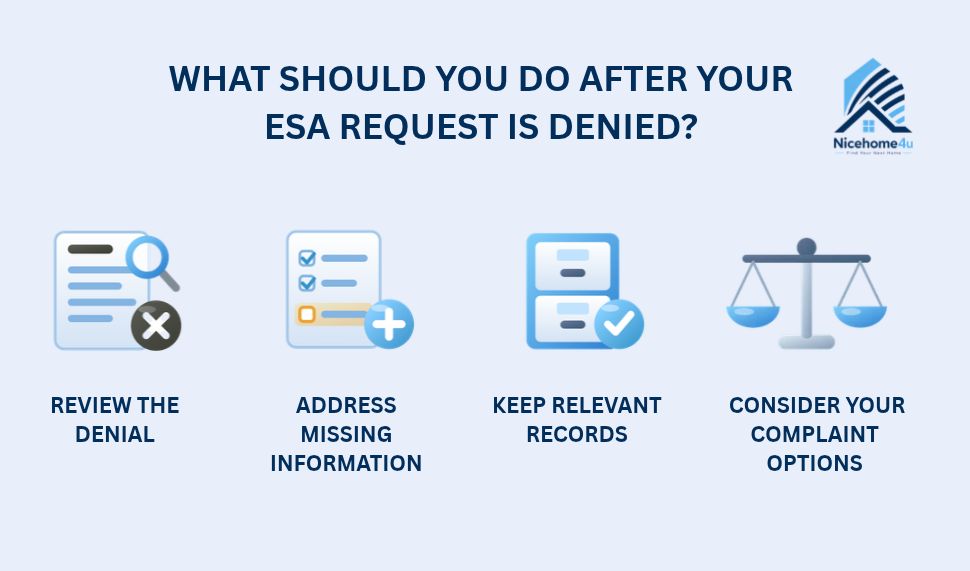
1. Review the Denial
Identify exactly what your landlord refused and the reason given. Check whether the response addresses your disability-related accommodation request or relies only on an ordinary lease restriction.
2. Address Missing Information
If your landlord identifies a specific gap in the information provided, consider whether you can clarify it. Keep your response focused on the accommodation request rather than volunteering complete medical records or unrelated health information.
For more detail on how to make an assistance-animal request and what information a housing provider may ask for, read our guide to emotional support animals, service animals, and regular pets.
3. Keep Relevant Records
Save your original request, supporting documents, and the landlord’s response. These materials may help explain what happened if you later need to discuss the denial with a fair housing organization or legal professional.
4. Consider Your Complaint Options
You can review HUD’s housing-discrimination complaint process or contact the Oklahoma Attorney General’s Office of Civil Rights Enforcement using its housing-discrimination complaint form. The Oklahoma Office of Civil Rights Enforcement requires housing discrimination complaints to be filed within one year of the last alleged unlawful housing practice.
Missing this deadline may result in losing the right to obtain relief through that state complaint process. HUD’s May 2026 enforcement policy also affects how FHEO evaluates complaints involving untrained emotional support animals. Consider speaking with a qualified Oklahoma housing attorney about which options may apply.
What If Your Landlord Ignores or Delays Your ESA Request?
If your landlord has not responded to your emotional support animal (ESA) request, follow up in writing rather than assuming the request has been denied. Ask whether the landlord needs any specific information to review it and when you can expect a decision.
A housing provider should respond promptly to a reasonable accommodation request. There is no single response deadline that applies to every situation, but an undue delay may amount to a failure to provide the requested accommodation. The length of the delay and the reason for it matter, especially if the landlord is waiting for relevant information or has left your request unanswered without explanation.
You can read more in the U.S. Department of Justice’s joint guidance on reasonable accommodations under the Fair Housing Act.
Understand Your Rights Before Giving Up on Your ESA Request
If you’re still wondering, can a landlord deny an emotional support animal? The answer depends on the applicable housing laws and the circumstances of your request. A landlord’s response does not necessarily mean you have no options, so take time to understand your rights before deciding what to do next.
If you have questions about an assistance-animal request for a Nicehome4u property, contact us. Our team can help explain the accommodation process and direct you to the appropriate next steps.
Disclaimer: This article is for general informational purposes only and is not legal advice. Fair housing requirements and their application can vary depending on the property and circumstances. Consult a qualified housing attorney for advice about your specific situation.