A reletting fee, sometimes called a reletting charge, is a cost your landlord may add when you end your lease early. It covers the cost of finding another tenant. Here is what most renters miss: paying a reletting fee does not always end your lease, so you may still owe rent after you pay it.
Maybe you took a new job, or you face a permanent change in your life, and now you are thinking about breaking a lease. Most renters are surprised by how many costs come with breaking a lease early, and the total depends on your apartment lease and on state law.
This guide explains the fee, how it differs from an early termination fee, and what Oklahoma law says when a tenant leaves early.
Reletting Fee: Key Facts
| Question | Short answer |
| What is it? | A fee for the landlord’s cost of finding a replacement tenant |
| Who charges it? | Landlords and property managers, if the lease requires it |
| How much? | The lease sets it, often as a flat fee or a share of a month’s rent |
| When is it charged? | When you break the lease early, and the clause applies |
| Is it refundable? | Usually not once charged, unless the landlord agrees in writing |
| Does it end the lease? | Only if the early termination clause says so |
What is a reletting fee on a lease?
A reletting fee is a lease-based charge that may apply when you leave early, and the landlord must rent the home to someone else. It usually covers advertising, showings, screening, and new lease preparation, depending on the lease wording. It is separate from the rent you may owe.
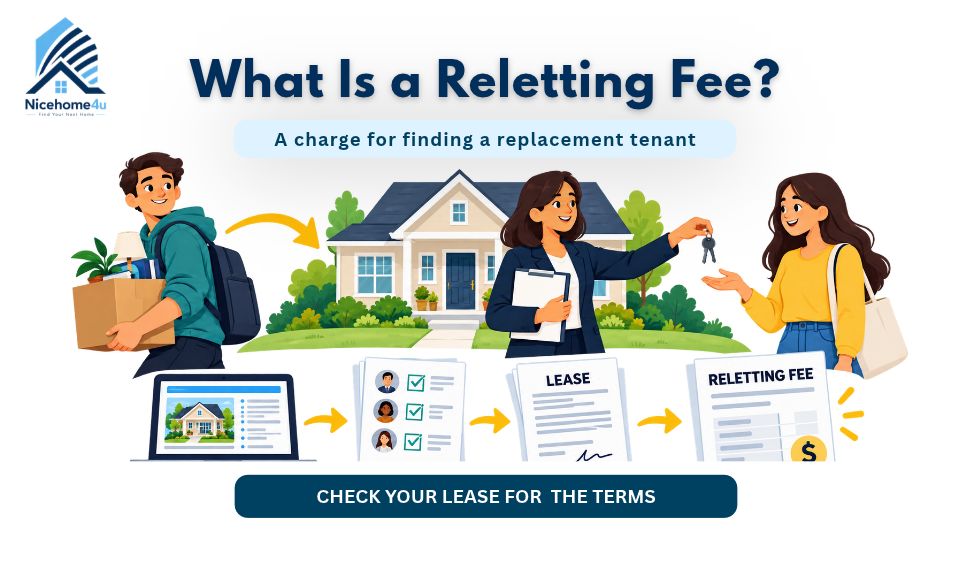
Your lease may call it a reletting charge, a re-rental fee. The name matters less than the wording around it. The fee usually pays for:
- Advertising the vacancy
- Showing the home to each new person who wants to rent it
- Pulling tenant screening reports, including credit and background checks
- Preparing a new lease for the next tenant
It is not a punishment, and it is not rent. Your regular rent payments are a separate matter, and the fee never replaces them. It is the landlord’s cost of reletting the home, passed on to the tenant who leaves.
How Much Is a Reletting Fee?
There is no single price. Your lease sets the reletting charge, often as a flat fee or a percentage of one month’s rent. The only number that counts is the one in the lease the tenant signs.
How fast a new tenant is found may or may not change the fee, so check the lease. Online guides quote very different ranges, so do not rely on a “typical” number. Use this example to see how it works (numbers are for illustration only):
- Monthly rent: $1,000
- Reletting fee in the lease: 50% of a month’s rent
- Fee owed: $500
That $500 covers only the fee. It does not include unpaid rent, damage beyond normal wear, late fees, or utilities. Some leases also add a set fee for cleaning or key replacement, so ask the landlord for an itemized list in writing that shows the reletting charge separately from other costs.
Check for a concession payback clause too, because concession payback terms are easy to miss. If you received free rent or a move-in special, the lease may require you to repay that discount when you leave early. Some landlords call this a concession clawback. It can add real money to your bill.
Is a Reletting Fee the Same as an Early Termination Fee?
No. A reletting fee pays for finding a new tenant. An early termination fee, also called a lease break fee, is a set price for ending the lease early. Some leases include both, so read each clause.
An early termination option in your lease may let you pay to end your lease before it is over. If your lease includes an early termination option, paying the fee may end the lease and your rent liability, but only if the clause says so. Always get the lease termination in writing, and confirm the lease termination date
A reletting fee often works differently, because it may not end your rent liability.
| Feature | Reletting fee | Early termination fee | Sublet | Lease assignment |
| What it is | Cost of finding a replacement | Set price to end the lease early | You rent the home to someone else | You transfer the lease to someone else |
| Who stays responsible | Often you, until re-rented | Usually you are released once paid, if the lease says so | You stay responsible to the landlord | The new tenant takes over, if the landlord agrees |
| Usual cost | The lease sets it | The lease sets it | Often none, but approval is needed | Sometimes an admin fee may apply |
| Ends your lease? | Depends on the wording | Often, if the lease says so | No | Often, if the landlord gives a signed release |
Lease break fee and early termination fee are often used to mean the same thing, but leases use these labels differently, so read the clause itself. A lease break can also bring other charges, such as a concession payback or cleaning costs. If your lease has both fees, ask the landlord in writing whether you owe one or both.
Do I Still Owe Rent If I Pay a Reletting Fee?
Often yes. Many leases make you pay rent until the home is re-rented or the lease ends, plus the fee. Some leases release you once you pay. Check your early termination clause for the exact wording.
Here is a sample clause, written as an example only (not from any real lease):
“If Tenant ends this lease early, Tenant will pay a reletting fee of 50% of one month’s rent. The tenant remains responsible for rent until a new tenant begins paying rent or the lease term ends, whichever happens first.”
Line by line:
- “Reletting fee of 50% of one month’s rent” sets the fee amount.
- “Tenant remains responsible for rent” is the key phrase. It tells you the lease does not end when you pay the fee, so you still pay rent, and your future rent stays on the books.
- “Whichever happens first” caps your remaining rent. Once a new tenant starts paying, your future rent stops.
If the clause says you are “released,” or that the lease “terminates” when you pay, the fee may end your lease. If the wording is unclear, ask the landlord to explain it in a written agreement.
A short timeline shows how it adds up:
- Your lease expires December 31, and your move-out date is September 30.
- A replacement tenant starts paying rent November 15.
- You may owe rent for October 1 to November 14, plus the fee.
When Do You Have to Pay a Reletting Fee?
You usually pay it when you give written notice to leave early, and your lease contains the clause. You usually do not pay it when the lease ends normally, or you leave through a legal exit.
Breaking a lease is what usually triggers the fee. It generally does not apply if:
- Your lease expires on its stated date, and you give proper notice
- The landlord agrees in writing to waive it
- You qualify for a legal early exit (see below)
If your lease does not mention a reletting fee, ask which clause supports the charge before you pay.
Your type of tenancy matters. A fixed-term lease runs for a set period, such as 12 months, so ending a fixed-term lease early triggers these costs. A month-to-month tenancy is different. You can usually end it with proper notice and no early termination, though Oklahoma has notice rules to follow, so check the statute and your lease.
Do Reletting Fees Apply in Oklahoma?
Oklahoma law does not set or cap reletting fees. But if a tenant wrongfully leaves, the landlord must make a reasonable effort to re-rent the home. What you owe depends on that effort and on your lease.

Breaking a lease in Oklahoma does not automatically erase your duty to pay what the lease says, but landlords have duties too. Section 129 of the Oklahoma Landlord and Tenant Act covers a tenant who wrongfully leaves and abandons the home before the lease term ends. In plain words, it says three things:
- The landlord must make reasonable efforts to make the home available for rent.
- If the landlord fails to make those efforts, or accepts the move-out as a surrender, the lease is treated as ended by the landlord from the date the landlord learns of the abandonment.
- If the landlord does make reasonable efforts but cannot re-rent at a fair rent, the tenant can owe the full rent, or the difference in rent, for the rest of the term.
In short, a landlord cannot leave your home empty and bill you for all remaining rent without trying to re-rent it.
Section 129 deals with rent. It does not say whether a flat fee for reletting is allowed. Whether a specific fee can be enforced depends on your lease wording and the law, and an unreasonable fee may be challenged. Do not assume the fee is always valid or always invalid.
Under § 105(B), the prevailing party in a lawsuit over a rental agreement is entitled to reasonable attorney’s fees. That is a good reason to settle disputes in writing before they reach court.
What Are Legal Reasons to Leave Early Without a Fee?
Some situations let you end a lease early without a reletting fee, including military service, family violence or sexual assault protections, and serious repair problems. Each has steps to follow, so check before you move.
- Military service. The federal Servicemembers Civil Relief Act lets eligible servicemembers end an apartment lease early, usually with written notice and a copy of their orders.
- Family violence and sexual assault. Federal law (the Violence Against Women Act) protects victims in covered housing. Oklahoma has its own rules for family violence, so ask a legal aid group before you rely on any of this.
- Serious repair or safety problems. If the landlord fails to fix major problems, you may have rights. You must follow the steps in your lease and in state law first.
Do not assume you qualify. Breaking a lease under one of these rules still requires the right paperwork. Check your lease and local law, and get advice before you move out.
Can You Avoid or Lower a Reletting Fee?
Yes, often. You can help find a replacement tenant, ask about a lease assignment or sublet, allow showings, and ask the landlord to waive or reduce the fee. Put every deal in a written agreement.
- Help find a replacement tenant. A qualified applicant can help the landlord find a new tenant faster and cut your costs.
- Ask about a lease assignment or sublet if your lease allows it. A lease assignment can move your rent liability to someone else, but only if the landlord approves in writing.
- Allow showings and leave the home clean.
- Ask for a waiver or a lower fee: Some landlords agree, especially if you are helpful.
- Get every agreement in writing, including any waiver, lower fee, assignment approval, or signed release. Keep making on-time rent payments while you negotiate.
What Happens If You Do Not Pay?
The landlord may deduct unpaid rent and fees from your security deposit, send the debt to a collection agency, or sue. Unpaid debts can hurt your credit report and make future rentals harder. A broken lease with a balance owed is a red flag for new landlords.
Possible results include:
- A deduction from your security deposit.
- A collection agency account, which may appear on your credit report.
- A court case and a court judgment if the landlord wins.
- A weaker rental record, since some tenant screening reports list past disputes and eviction filings.
A court judgment or collections account can cause lasting credit damage, and a broken lease on your rental record can show up when a new landlord checks your history. Negative items on your credit report can be hard to remove. If your credit takes a hit, our guide on renting with bad credit in Oklahoma explains your options.
Missed payments on a payment plan can add to the damage. If you cannot pay the full amount, talk to the landlord early and ask about a payment plan. Put any agreement in writing. If money is the reason you are leaving, read our guide on breaking a lease due to financial hardship.
If you think the landlord is acting in bad faith, for example by never trying to re-rent the home, keep records and ask a legal aid group for advice.
What Should You Do Before Breaking a Lease?
Use this as your final checklist before you send notice: confirm what your lease says about the fee and rent, deliver written notice the right way, and document your move-out.
- Find the reletting fee and the early termination clause in your lease
- Check whether the fee is a flat fee or a percentage
- Check whether rent continues until the home is re-rented, and whether next rent, due after you give notice, is still owed
- Check the required notice period in your lease, since a short notice can add to your cost
- Follow the notice rules in your lease. Send written notice by certified mail if the lease requires it, or by another method that gives you proof
- Write your termination date and move-out date in the notice, and keep a copy of the lease termination letter
- Do a move-out walkthrough before you move out, and take dated photos
- If the landlord sends an itemized bill, check the reletting charge and every other line against your lease
Conclusion
A reletting fee covers the landlord’s cost of finding a new tenant when you leave early. The amount and the rules come from your lease, and Oklahoma law adds the landlord’s duty to make a reasonable effort to re-rent. Before you send a written notice, find the reletting clause and read what it says about rent. Give notice early, help find a replacement tenant, and get every agreement in writing. If anything is unclear, ask the landlord to explain it in writing or contact a legal aid service.