
Renting a home in Oklahoma City means entering a legal relationship, not just a handshake deal. Both sides have obligations, and knowing your tenants rights under Oklahoma law can save you money, stress, and a lot of confusion down the road.
This guide breaks down what Oklahoma law says tenants and landlords each owe one another, whether you’re a house tenant in Edmond or an apartment tenant in downtown OKC.
We’ll cover the protections you’re entitled to, what’s expected of you in return, and what actually happens when something goes wrong, from a slow repair to a missed rent payment.
Key Takeaways
- Oklahoma tenants and landlords are both bound by the Oklahoma Residential Landlord and Tenant Act (Title 41), a lease can’t sign away these protections.
- Landlords must keep the unit habitable, generally give at least one day’s notice before routine entry, and return the remaining security deposit within 45 days after the tenancy ends, possession is returned, and the tenant makes a written demand.
- Tenants must pay rent on time, keep the unit in good condition, and give proper notice before moving out.
- “Self-help” evictions, lockouts, shutting off utilities, are illegal in Oklahoma. Every eviction requires a court order.
- Notice periods for eviction range from 5 days (nonpayment) to 15 days (lease violations, with a 10-day window to fix the problem).
Rights as a Tenant in Oklahoma: What Renters Should Expect
Oklahoma’s landlord-tenant law is officially the Oklahoma Residential Landlord and Tenant Act (Title 41 of the Oklahoma Statutes). It sets the floor for what landlords owe tenants, and a lease can’t waive these Oklahoma tenants rights just because both parties sign it.

The Right to a Safe, Habitable Home
Landlords must keep the property in compliance with local housing codes and in genuinely livable condition. That includes structurally sound floors, walls, and stairs; working plumbing; and heat during cold months. A broken heater in January, no hot water, or a serious pest infestation all count as habitability problems, not just inconveniences.
If something breaks and it affects health or safety, put the request in writing. From there:
- Qualifying health-related repairs: If a landlord’s material noncompliance affects health and the repair will reasonably cost one month’s rent or less, Oklahoma law may allow a tenant to use the repair-and-deduct process. The tenant must give proper written notice of the intent to correct the condition, allow the required 14-day period unless an emergency requires faster action, have the work completed properly, and provide an itemized statement before deducting the actual and reasonable cost from rent.
- Essential services (heat, running water, hot water, electricity, or gas): if a landlord willfully or negligently fails to supply a required essential service contrary to the lease or Oklahoma law, you may give written notice and use available legal remedies. Depending on the circumstances, these may include ending the lease immediately, obtaining the service and deducting the actual and reasonable cost, seeking damages based on reduced rental value, or obtaining substitute housing and being excused from rent during the noncompliance.
- Uninhabitable or urgent health/safety issues: you can terminate the lease right away with written notice if the landlord doesn’t act as quickly as the situation demands.
The Right to Privacy, Notice Before Entry
A landlord can’t just let themselves in. Except in an emergency or when advance notice is impracticable, Oklahoma law generally requires at least one day’s notice before routine entry for inspections, repairs, or showing the unit. Entry must also occur at reasonable times.A landlord who makes a habit of entering without notice can be on the hook for harassment — see what you can do if a landlord enters without permission for the exact steps to document it, complain, and pursue a court order, lease termination, or damages.
The Right to a Fair Security Deposit Process
Oklahoma law does not set a general statutory cap on how much a landlord may require as a security deposit, but the handling rules are specific:
- Deposits must sit in an escrow account at an Oklahoma-based, FDIC-insured bank, separate from the landlord’s own funds
- No interest is owed to you on the deposit
- You must make a written demand for the deposit within six months after the tenancy ends. If you do not, the deposit reverts to the landlord and your interest in it terminates.
- After the tenancy ends, you return possession, and you make a written demand, the landlord generally has 45 days to return the remaining balance and provide an itemized written statement of any deductions.
- Deductions may include accrued rent, damages caused by tenant noncompliance, and other legally allowable charges under Oklahoma law or the rental agreement. Ordinary wear from normal use should not be treated as tenant-caused damage.
You can find more on the return process from Legal Aid Services of Oklahoma, a free legal resource for renters.
How to Protect Your Security Deposit
The law sets the rules, but a little documentation on your end makes them much easier to enforce.
- At move-in: Walk the unit before you unpack, and take dated photos or video of every room, floors, walls, appliances, fixtures. Note any existing damage in writing and send it to your landlord, so it’s on record before you’ve lived there a single day.
- During the tenancy: Keep copies of rent payment confirmations and any written repair requests. If a dispute comes down to conflicting accounts, a clear paper trail can strengthen your record.
- At move-out: Clean thoroughly, take the same room-by-room photos or video you took at move-in, and work through a move-out checklist so nothing gets missed. Request a joint walkthrough with your landlord too, if they offer one.
- After you leave: Send your written request for the deposit back as soon as you have a forwarding address, don’t wait, since the six-month clock is the one deadline that’s entirely on you.
Protection From Discrimination
It’s illegal for a landlord to treat you differently, in advertising, screening, lease terms, or anything else, based on race, color, national origin, religion, sex, familial status (having kids), or disability. That’s federal Fair Housing Act protection, backed up at the state level by Oklahoma’s own Discrimination in Housing Act.
Protection From Illegal “Self-Help” Evictions
No matter how far behind on rent someone is, a landlord in Oklahoma cannot legally change the locks, shut off utilities, or remove belongings to force a tenant out. Every eviction has to go through the courts. If a landlord wrongfully locks you out, you may seek possession through the court or terminate the rental agreement after proper notice and may recover up to twice the average monthly rent or twice your actual damages, whichever is greater.
A Note for Housing Choice Voucher (Section 8) Renters
The Oklahoma landlord-tenant protections discussed above generally still apply when you use a Housing Choice Voucher. The main practical difference is an added layer of program coordination, for most of the OKC metro, that means your landlord and OHFA both need to sign off on inspections and paperwork before and during the tenancy, though this can vary depending on which housing agency administers your voucher.
Your Responsibilities as a Tenant Under Oklahoma Law
Rights go both ways. Here’s what Oklahoma law, and pretty much every lease, expects from you.
Pay Rent on Time
The rent on your lease is due exactly when your lease says it’s due. Oklahoma doesn’t require a grace period unless your lease includes one, so a payment can technically be considered late the day after it’s due.
Keep the Property Clean and Damage-Free
You’re responsible for keeping the unit sanitary and for any damage caused by you, your guests, or your pets, beyond ordinary wear and tear.
Report Problems Promptly
If something breaks, tell your landlord as soon as you reasonably can, and get it in writing. We hear from renters fairly often who assume a text message counted as a repair request; a message through email or your tenant portal is safer, since you’ll generally need to show you gave proper notice before using remedies like repair-and-deduct.
Follow Your Lease and Give Proper Notice
Stick to the terms you signed, pet policies, guest limits, subletting rules, and so on. If you’re planning to move out:
- Week-to-week rental: at least 7 days’ written notice
- Month-to-month rental: at least 30 days’ written notice
- Fixed-term lease: it ends on its own at the lease date; no notice is legally required unless your lease says otherwise, though giving one anyway is good practice
What Happens When Rent Is Late or a Lease Is Broken
Oklahoma law spells out exactly how an eviction has to unfold, and a landlord can’t skip these steps:
- Nonpayment of rent: the landlord must give a 5-day written notice to pay the full amount owed or move out.
- Lease violations (unauthorized pets, too many occupants, damage, and similar issues): the landlord issues a 15-day notice, but the tenant has the first 10 days of that window to fix the problem. Fix it in time, and the tenancy continues.
- Serious violations involving imminent and irremediable harm, or criminal activity that threatens health, safety, or the peaceful enjoyment of the premises, may allow termination without the usual cure period.
If the issue isn’t resolved by the deadline, the landlord’s next step is filing in district court, not showing up with a locksmith.
What to Do If You Receive a Rent or Lease Notice
Getting a notice taped to your door is stressful, but the steps that actually protect you are straightforward:
- Read it closely and note the deadline. A 5-day notice for unpaid rent and a 15-day notice for a lease violation call for different responses, know which one you’re holding before you do anything else.
- Act within the window, not after it. For nonpayment, pay the full amount owed (not a partial payment) and get a receipt. For a curable violation, fix the problem within the first 10 days and document that you did it, photos, a message to your landlord, whatever proves it.
- Put your response in writing, even if you’ve also talked to your landlord in person or by phone. A text or email creates a written record you can refer back to later.
- Don’t assume the notice period ending means you’re out. Oklahoma law still requires your landlord to file in court and get a judge’s order before anyone can remove you, the notice by itself isn’t an eviction.
- Ask for help if you’re stuck. Legal Aid Services of Oklahoma offers free assistance to renters facing eviction, and plenty of cases get resolved before they ever reach a courtroom.
Quick Reference Checklist
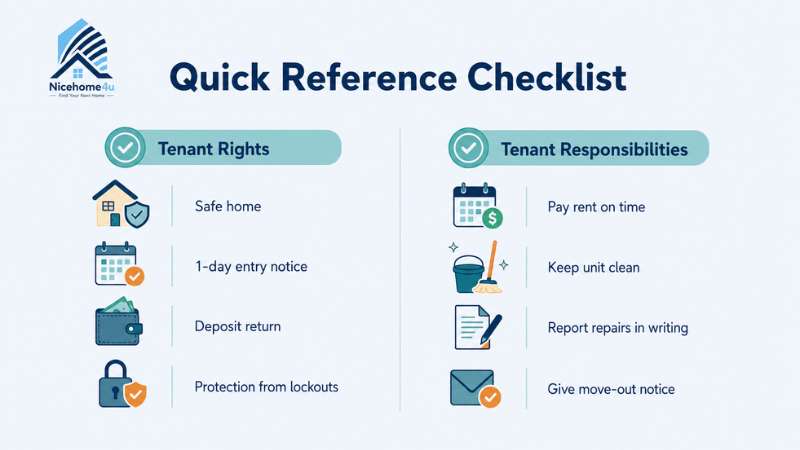
As a tenant, you’re entitled to:
- A safe, code-compliant home
- At least 1 day’s notice before non-emergency entry
- Protection from discrimination and illegal lockouts
- Security deposit return after move-out and written demand, subject to Oklahoma’s 45-day rule
As a tenant, you’re responsible for:
- Paying rent on time, per your lease
- Keeping the unit clean and undamaged
- Reporting maintenance issues in writing
- Giving proper notice before moving out
The Bottom Line
Oklahoma’s landlord-tenant law draws a fairly clear line: landlords keep the property safe and respect your privacy, and tenants pay rent and take care of the place. Most disputes come down to one side or the other skipping a step, usually the written notice that everything else depends on.
This is the kind of guide worth bookmarking for the next time a question comes up. If you’re renting with us, your tenant portal is the fastest way to submit a maintenance request or ask a question directly, and our local OKC team is on the other end whenever you need us.
This article is for general information and reflects Oklahoma law. It isn’t legal advice. For help with your specific situation, Legal Aid Services of Oklahoma offers free assistance, or consult a licensed Oklahoma attorney.