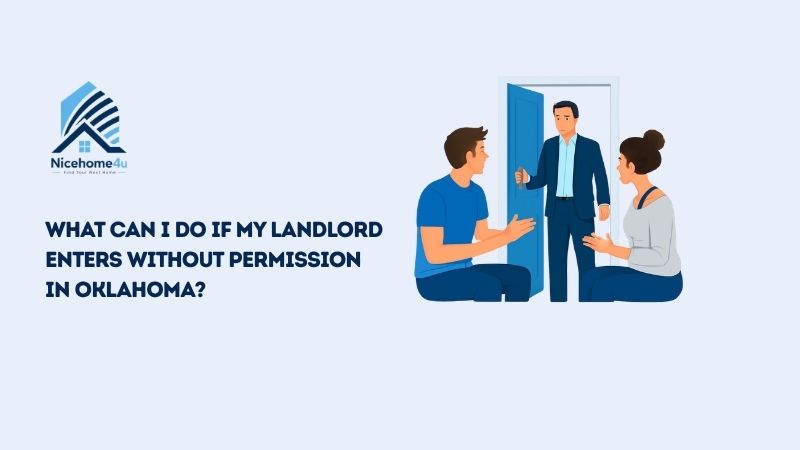
A landlord owns or manages a rental home, but that ownership doesn’t give them an unlimited right to walk in whenever they choose. A tenant possesses the home under the lease, and Oklahoma law gives landlords only a limited right of access, tied to a specific purpose, proper notice, and reasonable timing.
If you are asking, “What can I do if my landlord enters without permission?” you have options. Document what happened, send a written complaint, ask for a clear entry process going forward, and seek legal advice if the behavior continues. Oklahoma law may also provide remedies for unlawful or unreasonable entry and repeated demands for access that amount to harassment.
The key is telling an uncomfortable visit apart from an unlawful one. That comes down to a few specific factors: whether proper notice was given, why the landlord wanted access, what time they came, whether it was a true emergency, how you responded, and what your lease says.
This article is general educational information, not legal advice. Laws and outcomes vary with the specific facts, so review your lease and talk to a qualified Oklahoma attorney before taking legal action or ending your tenancy.
Key Takeaways
- Confirm the landlord had a purpose the law actually authorizes.
- Check that you got at least one day’s notice, at a reasonable time.
- Remember that a genuine emergency is an exception to notice and permission.
- Document every unauthorized visit — dates, messages, witnesses, photos, and camera footage.
- Notify management in writing and ask for a compliant process going forward.
- Talk to an attorney before terminating the lease, withholding rent, changing locks, or taking legal action.
What Steps Can I Take After My Landlord Enters Without Permission?
- Document the visit right away — see “How do I document unauthorized landlord entry?” below for exactly what to capture.
- Check your lease’s entry clause against 41 O.S. § 128.
- Send a written complaint to the landlord or property manager, and keep a copy.
- Ask for proper notice, a reasonable window, a valid purpose, and the visitor’s identity going forward.
- Contact an attorney if it happens again, if your tenancy is threatened, or if you’ve suffered a loss.
Stick to the facts. Avoid words like “burglary” or “trespassing” unless a lawyer confirms they apply; an unauthorized entry can be a civil violation without being a crime.
How Do I Document Unauthorized Landlord Entry?
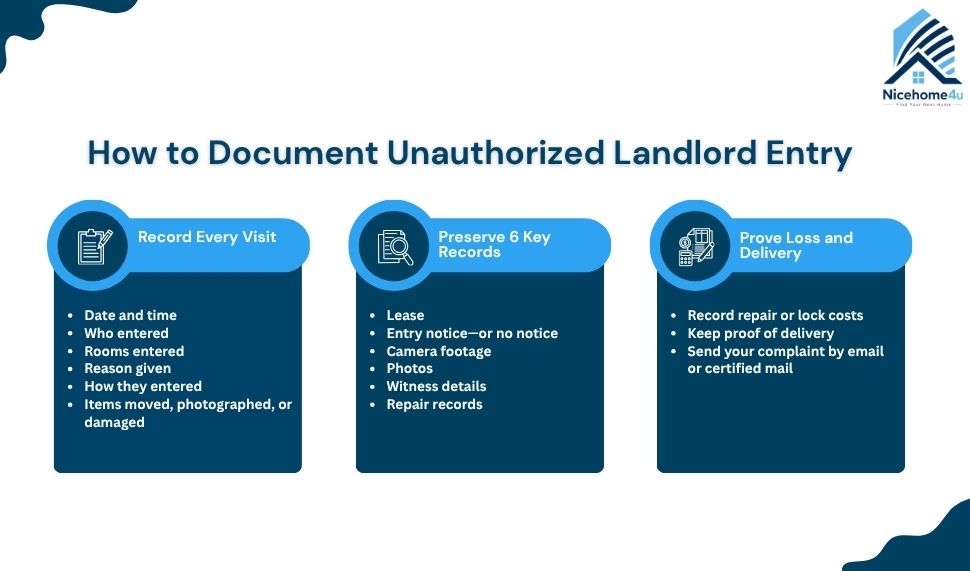
Keep one running, written record of every visit: the date, who came, which rooms they entered, what reason they gave, and whether they knocked, used a key, or entered after you’d objected. Note anything moved, photographed, or damaged.
Six things are worth preserving: your lease, the entry notice (or lack of one), camera footage, photos, witness names and contact details, and any related repair records. Back up originals somewhere secure.
If you’re claiming actual damages, like a lock replacement or property repairs, document the specific loss; a judge decides what’s recoverable. Send your written complaint by a traceable method, like email or certified mail, and keep proof it was delivered.
One more thing: check whether recording audio is legal in your situation before you do it, and be mindful of other people’s privacy while you document.
When Can A Landlord Legally Enter A Rental Property In Oklahoma?
Under 41 O.S. § 128(A), a landlord or their agent or employee can enter to:
- Inspect the condition of the unit
- Complete necessary or agreed repairs
- Perform agreed decorations, alterations, or improvements
- Supply necessary or agreed services
- Show the unit to prospective or actual purchasers
- Show the unit to mortgagees, tenants, workers, or contractors
You can’t unreasonably refuse access for these purposes. Inspections can cover maintenance, safety, lease compliance, or damage beyond normal wear and tear. “Repairs” covers diagnosing the issue, doing the work, and following up to confirm it’s fixed, whether the landlord does it personally or sends an employee or contractor. Either way, the landlord stays responsible for keeping the visit to its stated purpose — separately from which repairs are actually the tenant’s responsibility versus the landlord’s.
How Much Notice Must A Landlord Give Before Entering?
Oklahoma law requires at least one day’s notice before entry (41 O.S. § 128(C)). The statute uses that exact phrase rather than “24 hours,” so a lawyer can help if the timing of a specific notice is disputed.
That notice gives you a chance to secure pets, protect your belongings, or flag a genuine scheduling conflict before the landlord arrives, and it applies to planned inspections, showings, services, and repairs.
The law doesn’t require notice in writing. A landlord can notify you by email, text, a resident portal, mail, or hand delivery, and your lease can specify which method to use as long as that doesn’t conflict with state law.
What Should Be Included In A Notice Of Entry?
Oklahoma law doesn’t legally require these details, but a clear notice should include:
- The specific date
- The expected arrival time or a limited window
- The reason for entry (inspection, repair, service, improvement, or showing)
- Who’s coming: the landlord, an employee, an agent, or a contractor
- A way to reach someone with questions
- Any prep needed, like securing a pet or clearing space for a repair
Compare “someone will stop by soon” with no date, no window with “An HVAC contractor will inspect the air conditioner on September 4th, between 10 a.m. and noon.” The second version leaves no room for confusion.
What Is A Reasonable Time For Landlord Entry?
Oklahoma law doesn’t set exact hours; what counts as “reasonable” depends on the purpose. A routine inspection normally happens during the day or at an agreed time; a contractor’s visit should match their working hours and the expected length of the job. Normal business hours are a useful guideline, but being technically within business hours doesn’t automatically make a visit reasonable.
You can ask to reschedule because of work, a medical appointment, or a pet, but you can’t use repeated objections to block every lawful visit.
How the landlord behaves during the visit matters too. Knocking, announcing themselves, and sticking to the stated purpose are signs of reasonable conduct. Searching through private belongings or wandering into unrelated rooms is not.
There’s no legal limit on how many inspections a landlord can do in a year, but repeated, unreasonable demands to enter can amount to harassment under 41 O.S. § 124 even when each request has a valid purpose on paper.
When Can Landlords Enter Without Notice Or Permission?
Four situations let a landlord skip notice or permission:
- Emergencies. A landlord can act immediately on a real emergency: an active fire, a suspected gas leak, a burst pipe but only to the extent needed to control that danger. A scheduled fire-alarm check is routine maintenance, not an emergency, and still follows the normal notice rules, Unsure which one you’re dealing with? See emergency repairs vs. routine maintenance.
- Impracticability. Section 128(C) also excuses the one-day notice when giving it is genuinely impracticable. The law doesn’t define that word, and simply forgetting to notify you doesn’t count.
- Abandonment or surrender. Once you’ve abandoned or surrendered the unit (41 O.S. § 128(D)), the landlord can enter freely. But a temporary absence, a hospital stay, or an unanswered message doesn’t prove abandonment, and having a key doesn’t excuse skipping notice for a routine visit, like a scheduled showing or filter change.
- Court order. A valid court order can separately authorize entry.
Can A Tenant Refuse Entry To A Landlord?
You can object when a visit lacks a lawful purpose, proper notice, reasonable timing, or respectful conduct, but you can’t unreasonably refuse entry for the purposes listed above.
If something’s off, say so and offer a fix: point out that no notice arrived, ask what the visit is for, or propose another time. A flat refusal is riskier: Section 128(E) lets a landlord seek an injunction, a court order, or terminate the lease if a tenant refuses lawful access. Don’t physically block a lawful visit or change the locks to prevent it; that can itself count as a lease violation.
Put rescheduling requests in writing, and make clear it isn’t a refusal:
“I am not refusing a lawful landlord visit. I can let the landlord or contractor in tomorrow between 2:00 p.m. and 4:00 p.m. Please confirm the purpose and visitor.”
What Legal Remedies Exist For Unlawful Landlord Entry In Oklahoma?
Under 41 O.S. § 124, unlawful entry, entry carried out in an improper manner, and harassment through repeated unreasonable demands can each lead to three possible remedies: an injunction (a court order stopping the behavior), lease termination with written notice, or actual damages for a proven loss.
One exception: Section 124 doesn’t apply if the landlord was executing a valid writ under 12 O.S. § 1148.10A; a landlord can’t create that authority just by claiming it.
Because the right remedy depends on your specific facts and evidence, and Section 124 doesn’t automatically cover things like withholding rent, this is a good point to get advice rather than act alone. Two places to start: Legal Aid Services of Oklahoma offers tenant demand letter templates, including one for unlawful entry, and the Oklahoma City University School of Law Tenant Rights Clinic advises Oklahoma tenants, subject to its eligibility rules.
Conclusion
The right response depends on the pattern and the harm. Treat one unclear visit as a scheduling problem, repeated unannounced visits as an access dispute, and forced or threatening entry as a safety issue. That distinction keeps your response proportionate and preserves a workable tenancy when the problem is correctable.
Choose one outcome before you respond: clarification, a firm access boundary, compensation for a documented loss, or protection from continued entry. That outcome determines whether the next communication belongs with management, a tenant attorney, or emergency services.
Entry rules are one piece of a bigger picture — see our full guide to tenant rights and responsibilities in Oklahoma for the rest of what your landlord owes you and what you owe them.