
If you’ve ever moved into a new apartment or rental home, you may see the phrase “quiet hours” in your lease agreement or community rules. But what does it actually mean, and what happens if you or your neighbor don’t follow it? Here’s everything renters need to know.
What Are Quiet Hours, Exactly?
Quiet hours are set times, usually late evening through early morning, when noise in your building needs to stay low so everyone can rest, sleep, or simply enjoy their home in peace.
This doesn’t mean total silence. Because sound travels through walls, even ordinary activities can seem louder at night. Normal conversation, a TV at a reasonable volume, and everyday sounds like footsteps or a flushing toilet are all still fine, along with other sounds that stay reasonable during quiet hours. What common quiet time actually restricts is unnecessary noise like:
- Loud music or blasting music
- Parties or loud gatherings
- Shouting, singing, or loud phone calls
- Heavy chores: vacuuming, drilling, moving furniture
- Slamming doors or repeatedly running loud appliances
What Time Is Quiet Time, Usually?
Since the specific times come from your lease rather than a citywide law, they do vary. That said, most OKC-metro rentals land in a pretty similar range:
- Start: around 10 PM
- End: somewhere between 5 AM and 8 AM
- Weekdays: often 10 PM to 7 AM
- Weekends: usually a bit more lenient, commonly 10 PM to 8 AM or 11 PM to 8 AM
- Some buildings or properties instead use 9 PM to 7 AM or 11 PM to 7 AM
Quiet hours are mainly an overnight rule. During the day, normal living noise like kids playing, footsteps, or routine household activity is generally fine. That said, excessive or nonstop daytime noise, like industrial-level equipment or repeated loud gatherings, can still violate your lease or local law even outside the official quiet-hours window.
Why Do Quiet Hours Matter?
Quiet hours aren’t just an arbitrary rule tacked onto your lease agreement. They serve a real purpose:
- They help residents sleep, relax, and recharge without disruption
- They set one consistent, fair standard, since noise tolerance is different for everyone
- They prevent disputes by giving neighbors a shared, clear expectation
- They give landlords a simple, consistent way to resolve noise complaints
- They build a sense of shared responsibility in a community where people live close together, which is also part of being a good neighbor
When most residents share the same baseline expectation, noise issues are easier to resolve.
Who Actually Sets Quiet Hours in Oklahoma?
Here’s the part a lot of renters get wrong: unlike many cities that set one fixed quiet-hours curfew, there’s no single Oklahoma law that hands you a specific quiet-hours clock. Instead, three things work together.
Your lease or community rules usually establish the quiet hours for your property. Oklahoma law allows landlords to adopt rules that promote residents’ peace, safety, or welfare, but those rules must be reasonable, clear, fairly applied, and properly disclosed to tenants.
Oklahoma City’s noise ordinance appears in Chapter 34 of the Municipal Code. It does not establish one universal quiet-hours schedule for every rental. Instead, city rules regulate different types and levels of excessive noise, including standards that can vary by time of day.
The Oklahoma Residential Landlord and Tenant Act also requires tenants, and the guests, animals, or pets they allow on the property, not to disturb other tenants’ quiet and peaceful enjoyment. If your rental is outside Oklahoma City limits, check that city’s ordinance because nearby communities may have different rules.
What Happens If You Break Quiet Time in Oklahoma?
Consequences usually depend on your specific lease and how often the issue happens, and landlords or local officials may follow up after a report if the problem continues; there’s a pattern most OKC landlords follow:
- First offense: Usually just a warning
- Repeated noise violations: Written notices or other consequences permitted by the lease or applicable law
- Serious or ongoing issues: Can involve local enforcement, and in extreme cases, chronic noise complaints may result in eviction or put your lease renewal or tenancy at risk
Here’s the Oklahoma-specific part: If repeated noise becomes a material violation of the lease or a tenant’s duties under Oklahoma law, the landlord may provide written notice stating that the rental agreement will terminate at least 15 days after the notice is received unless the violation is corrected within 10 days. If the tenant corrects the initial violation within that period, the lease does not terminate for that breach. A later breach can have more serious consequences. Different procedures apply when conduct causes or threatens imminent and irremediable harm or involves qualifying criminal activity. Most landlords, including us, would much rather work it out directly with you than get anywhere near that process.
How to Handle a Noisy Neighbor
If someone else’s noise is the problem, here’s a level-headed way to approach it:
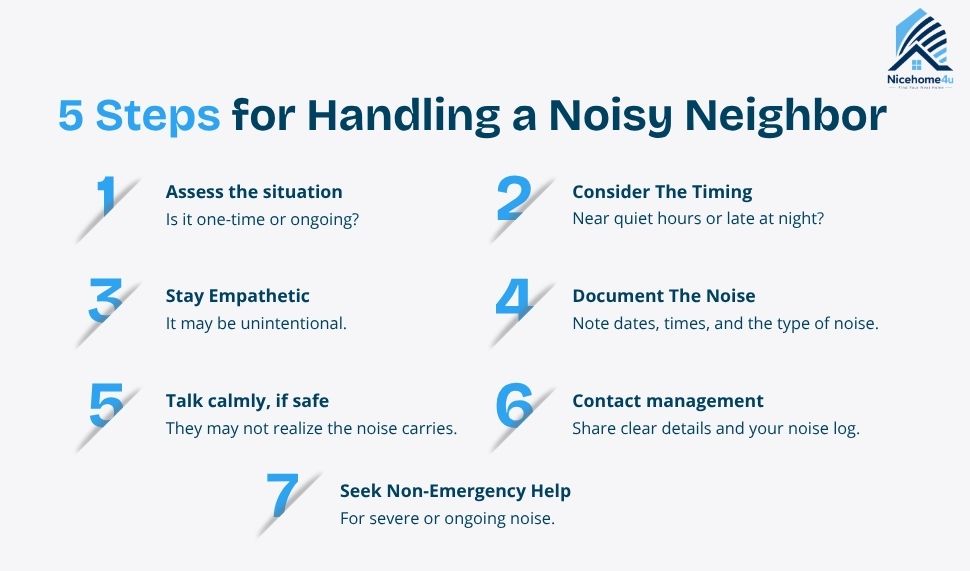
- Assess how serious it is. Is the noise coming from a one-time event, or is it ongoing? Mildly annoying, or actually keeping you up or interrupting your work?
- Consider the timing. Is it happening right at the edge of quiet hours, like 10:05 PM, or deep into the night?
- Stay empathetic. Parties, pets, a new baby, or a late-night visitor can all cause one-off, unintentional noise. It’s not always a pattern.
- Document it. Note dates, times, and the type of noise. This matters if you need to escalate later.
- Talk to them directly, calmly, if you feel safe doing so. They may genuinely not realize their TV echoes through the wall or their dog barks while they’re out.
- Loop in your landlord or leasing office if the direct conversation doesn’t help, especially if you have documentation ready.
- For severe or ongoing cases, a local non-emergency noise complaint line is also worth knowing about.
It’s worth turning that same lens on yourself, too. Are your speakers louder than you realize at night? Does your dog bark while you’re out? Did last weekend’s get-together run later than planned? A noise complaint isn’t necessarily a personal attack. It’s just a nudge to double-check your own habits.
Finding Your Exact Quiet-Hours Policy
Still hunting for a rental in the OKC metro? Quiet hours are actually one of the neighborhood questions worth asking before you sign anything; check out our list of questions to ask before renting a home for the full set.
Already signed a lease and getting ready to move in? Confirming the property’s quiet-hour rules is a quick item to add to your move-in checklist, right alongside parking, trash, and laundry rules.
Already living there and just need to double-check? Start with your lease; look for a section called “Quiet Hours,” “Noise Policy,” or “House Rules.” If you can’t find anything there, check for posted rules in common areas like the lobby, elevator, gym, or laundry room, or in your resident portal or welcome packet. Still unsure? Just ask your landlord or property manager directly.
Tips for Respecting Quiet Hours
- Know your lease’s rules from day one, so you don’t break them by accident, and check it to confirm the exact quiet hours and any building-specific expectations
- Schedule noisy chores like vacuuming or repairs for daytime hours; many renters solve minor noise issues by adjusting routines before management gets involved
- Host bigger parties or gatherings somewhere else instead of at home
- Add rugs, curtains, or foam mats to your space. They genuinely help decrease noise
Tips for Making the Most of Quiet Hours
Quiet hours don’t have to feel like a restriction. They can double as a built-in wind-down period:
- Unplug your electronics, or switch to headphones for late-night shows
- Try a quiet hobby: reading, journaling, knitting, or calm music
- Use the time to prep for tomorrow: lay out clothes, plan meals, pack a bag
- Try white noise or soft lighting to help you sleep better
- Respect your roommate’s schedule too, even on nights you’re wide awake
Conclusion
Quiet hours aren’t about being silent 24/7. They’re about being considerate. Whether you’re renting an apartment near downtown OKC or a house out in Moore or Mustang, it’s always worth double-checking your own policy. But the underlying idea is the same: everyone deserves a peaceful place to come home to, and that only works if everyone, including you, keeps that in mind.
This article is for general information and reflects Oklahoma law as of publication. It isn’t legal advice. For help with a specific situation, consult a licensed Oklahoma attorney or contact Legal Aid Services of Oklahoma.