Every renter eventually faces the same decision: sign a lease for a set period or choose a monthly arrangement that keeps future options open.
Choosing the wrong structure may leave you committed to a home that no longer fits your plans—or paying more for flexibility you never use. The Month-to-Month Lease vs. Fixed-Term Lease decision can affect your housing costs, moving timeline, renewal options, and responsibilities when your job, family, or budget changes.
We often help Oklahoma City renters compare these options, and the honest answer is that neither one is automatically better. Each serves a different type of renter. This guide explains how both arrangements work, the main Oklahoma rules to understand, and what to review before signing.
The Core Difference
A fixed-term lease covers a defined rental period, often 12 months, with a stated end date and terms that generally remain consistent throughout the agreement. A month-to-month lease continues from one monthly rental period to the next until the landlord or tenant properly ends it.
That’s the short version. Here’s what it actually means for your wallet, your finances, and your legal footing under the Oklahoma Residential Landlord and Tenant Act.
| Fixed-Term Lease | Month-to-Month Lease | |
| Length | Set period (often 12 months) | Continues each monthly rental period |
| Rent changes | Generally established for the term | May change for a future rental period |
| Ending it | Generally expires on its stated end date | Requires 30 days’ written notice |
| Best for | Renters who want stability | Renters who need flexibility |
What Is a Month-to-Month Lease?
A month-to-month lease is exactly what it sounds like: an arrangement that renews every month, with no fixed end date. It continues indefinitely until the landlord or tenant decides to end it.
How Rent and Notice Work
- With a month-to-month lease, the landlord may propose a different rent or updated terms for a future rental period. Review the written notice, effective date, and your rental agreement before deciding whether to continue the tenancy.
- Under Oklahoma law, this kind of arrangement requires at least 30 days’ written notice from either the landlord or the tenant before ending the tenancy (Okla. Stat. tit. 41, § 111).
- If there is no written lease and rent is paid and accepted monthly, the arrangement may be treated as a month-to-month tenancy. A fixed lease may also convert to month-to-month when the tenant remains after expiration with the landlord’s consent.
Ending It
- Either party can end the tenancy by giving notice — no long-term commitment required.
- The 30-day notice period begins on the date the termination notice is properly served.
- Notice requirements under the ORLTA are specific about delivery method (more on that below), so getting the paperwork right matters as much as the timing.
We often hear from tenants who assume a monthly arrangement always costs more. Some properties do charge a higher rate for the added flexibility, but pricing varies by property, availability, and lease options — and for someone who isn’t sure how long they’ll be in town, that’s often worth the extra cost.
What Is a Fixed-Term Lease?
A fixed-term lease is a rental agreement between a landlord and a tenant with a specific start date and end date written into the contract. Most fixed-term leases in Oklahoma City run 12 months, though you’ll also see 6-month or even 18-month versions depending on the property.
How Rent and Renewal Work
- Rent generally remains unchanged during the fixed lease term unless the agreement allows a specific adjustment or both parties approve a written change.
- A fixed-term tenancy generally expires on its stated ending date unless the parties or lease agreement provide otherwise.
Ending It Early
- Leaving before the end of a fixed-term lease may result in an early-termination fee or responsibility for the landlord’s actual losses. However, Oklahoma landlords generally must make reasonable efforts to re-rent the property rather than allowing avoidable losses to continue. Before taking action, learn when you can break a lease early in Oklahoma, review the early-termination clause, and obtain any release in writing.
In our experience, renters who expect to remain in the same home often appreciate the predictable timeline of a fixed agreement. It can make budgeting easier when the rent and recurring charges are clearly established for the lease term.
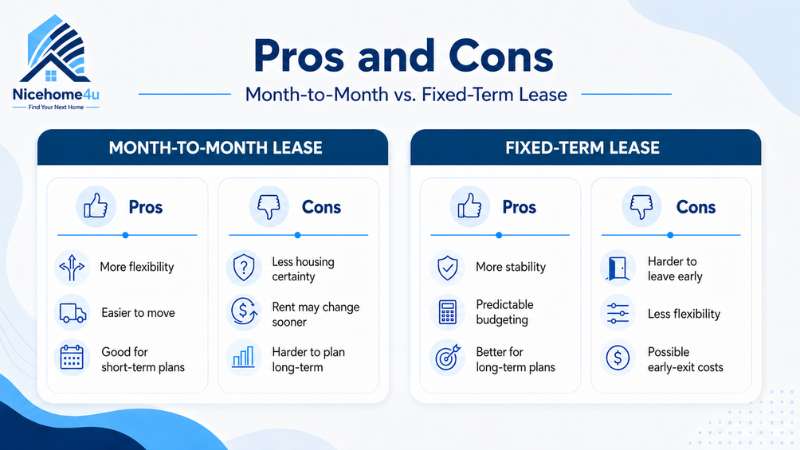
Pros and Cons: Month-to-Month and Fixed-Term Leases
Pros and Cons of a Month-to-Month Lease
A monthly tenancy gives you more control when your plans are uncertain, but it may also create greater housing and budget uncertainty.
Advantages
- Easier relocation: You can generally end the tenancy after following the required written-notice process.
- Shorter commitment: You do not have to commit to living in the property for a full year.
- Useful during transitions: It can work well while relocating, house hunting, changing jobs, or testing a neighborhood.
- Frequent decision points: You can regularly reconsider whether the home still fits your needs.
- Lower early-exit risk: You usually do not need to break a longer agreement when you follow the proper termination process.
Disadvantages
- Less housing certainty: Either party may decide to end the arrangement after giving the required notice.
- Possible higher monthly cost: Some properties charge more for the added flexibility.
- More frequent changes: A future rent increase or policy change may affect you sooner.
- Shorter planning period: You may need to find another home with less preparation time.
Pros and Cons of a Fixed-Term Lease
A fixed agreement offers more stability but may be difficult or costly to leave before the stated end date.
Advantages
- Predictable occupancy: You know how long the agreement is intended to remain in effect.
- More stable housing costs: Rent is generally established for the active term unless the contract allows a specific change.
- Easier budgeting: A predictable payment structure can support household financial planning.
- Greater housing stability: You are less likely to face an unexpected nonrenewal during the active lease term.
- Fewer renewal decisions: You do not have to reconsider the arrangement every month.
Disadvantages
- Stronger commitment: You remain responsible for the agreement even when your personal plans change.
- Possible early-termination costs: Leaving before expiration may result in fees or continued rent responsibility.
- Less mobility: A job transfer, family change, or new opportunity may not automatically release you.
- Potential renewal increase: The landlord may offer a higher rate when the current term ends.
The key question is not which lease is universally better. It is which risk you are more prepared to manage: less housing certainty or a longer contractual commitment.
Oklahoma Lease Rules Renters Should Understand
Oklahoma’s 30-Day Notice Rule
Oklahoma law generally allows either the landlord or tenant to terminate a month-to-month tenancy by serving written notice at least 30 days before the termination becomes effective. The 30-day period begins on the date the termination notice is properly served.
Do not assume this always means you can move exactly 30 calendar days after writing the notice. The rental-payment cycle and the agreement may affect the final date.
For example, the Oklahoma Bar Association explains that notice delivered on March 3 may result in a move-out date at the end of April when the tenancy follows a calendar-month rental cycle. Some landlords may allow mid-month termination, but renters should obtain that agreement in writing. How much notice to give before moving out in Oklahoma before selecting your final termination date.
Before sending notice, confirm:
- The date you want the tenancy to end
- Where the notice must be delivered
- The delivery method required
- The rent owed through the final date
- Whether the landlord confirms receipt
Keep a copy of your notice and evidence showing when and how it was delivered.
Fixed-Term Expiration and Holdover Tenancy
Under Oklahoma law, a tenancy for a definite term generally expires on its stated ending date without notice unless the parties agreed otherwise. However, the lease agreement may still require notice of nonrenewal, so you should also follow the signed contract.
Before the expiration date, one of several things may happen:
- You move out and return possession.
- You sign a new fixed agreement.
- You accept updated renewal terms.
- The landlord agrees to continued monthly occupancy.
- You stay without authorization and become a holdover tenant.
If a tenant remains after expiration with the landlord’s consent, Oklahoma law generally creates a month-to-month tenancy unless the parties agree to another arrangement.
Remaining without consent is different. The landlord may pursue possession and damages. If the holdover is willful and not in good faith, the law may allow damages of up to twice the average monthly rent, prorated for the holdover period.
Do not assume that sending another rent payment automatically permits you to stay. Confirm the new arrangement in writing before the current agreement expires.
Proper Notice Delivery
A correctly written notice may still create problems if it is not properly served.
Oklahoma law generally requires personal service of a tenancy-termination notice. When the tenant cannot be located, the law provides alternatives involving delivery to a qualifying family member or posting the notice and mailing a copy. If personal service cannot be made on the landlord, the notice is mailed by certified mail.
Your contract may also identify a management office, online portal, or designated notice address. Review both the agreement and applicable notice requirements.
A casual conversation, unsupported text message, or undelivered email may not provide enough evidence if the move-out date is later disputed.
Security-Deposit Return Requirements
The lease type generally does not change Oklahoma’s basic security deposit return process.
After the tenancy ends and you return possession, make a written demand for the deposit. If the landlord keeps part of it for accrued rent, damage, or another legally permitted charge, the landlord must provide a written itemized statement. Follow the resident move-out checklist to document the property, return the keys, and complete important move-out steps.
Oklahoma law generally requires the remaining balance to be returned within 45 days after the tenancy terminates, possession is delivered, and the tenant submits a written demand. The demand must generally be made within six months after termination.
To protect yourself:
- Take dated move-in and move-out photos.
- Return all keys and access devices.
- Keep receipts and maintenance communications.
- Submit the written demand promptly.
- Provide a reliable forwarding address.
- Keep proof that the demand was delivered.
Questions to Ask Before Signing a Lease Agreement
In our experience, clear documentation prevents more problems than verbal assurances. If this is your first rental, review our first-time renter’s guide before comparing lease options. Then ask these questions before accepting either lease type:
- What are the exact start and end dates?
- What is the total monthly cost?
- Does the agreement automatically renew?
- Can it convert to monthly status after expiration?
- How much notice must I give before leaving?
- Where and how must notice be delivered?
- Can rent or recurring charges change during the agreement?
- What happens if I need to move early?
- Are replacement tenants or subleases allowed?
- What happens if I remain after the end date?
- What are the move-out inspection requirements?
- How do I request the return of my deposit?
- Are all promises and special conditions included in writing?
Pay particular attention to words such as “expiration,” “termination,” “renewal,” “notice,” and “holdover.” They describe different legal events and should not be treated as interchangeable terms.
Common Lease Mistakes Oklahoma City Renters Should Avoid
Assuming 30 Days Always Means Exactly 30 Calendar Days
The effective date may depend on when notice is served and how the rental period is calculated. Confirm the final date before arranging your move.
Waiting Until the Final Week to Review Renewal Terms
Read the renewal and nonrenewal clauses several months before a fixed agreement ends. This gives you time to compare costs and plan another move when necessary.
Relying on Verbal Permission
A verbal promise about moving early, adding an occupant, keeping a pet, or extending the tenancy can be difficult to prove. Request written confirmation.
Staying Past the End Date Without Approval
Continued occupancy does not always create an automatic renewal. Obtain written confirmation before remaining beyond the stated expiration date.
Ignoring the Total Monthly Cost
Compare utilities, pet charges, required services, and recurring fees, not only the base rent.
Forgetting to Request the Deposit in Writing
Returning the keys is not the only step. Submit a written demand and keep evidence showing it was delivered.
Which Option Is Right for You? A Quick Self-Check
Ask yourself these questions before signing anything:
- Do I expect to remain in the home for the entire lease term? If yes, a fixed-term lease may provide more predictable housing costs.
- Could my job or living situation change in the next few months? If yes, staying month-to-month protects you from being stuck.
- Am I trying to save money on rent? Longer commitments usually offer a lower monthly rate than shorter, more flexible ones.
- Do I need the freedom to leave with just 30 days’ notice? That’s the defining advantage of a periodic tenancy.
- Am I moving to a new part of Oklahoma City and unsure about the neighborhood? Going month-to-month lets you test it out before committing to a longer lease.
There’s no wrong answer here, just the answer that matches where you actually are in life right now.
Final thought
Choosing between a month-to-month lease and a fixed-term lease depends on your expected timeline, budget, and need for flexibility. A monthly agreement may be more suitable when your plans could change soon, while a fixed agreement may provide better stability when you expect to remain in the property for the full lease term.
Before signing, review the rent, notice requirements, renewal conditions, early-termination clause, and holdover terms. Keep the lease agreement, payment receipts, notices, and any approved changes in writing.
Explore available Oklahoma City rentals through NiceHome4U, learn how to apply for a property, and ask about lease duration, renewal options, and move-out notice requirements before submitting your application.