
A regular pet, an emotional support animal, and a service animal are not the same under the law. Ordinary pets are generally governed by a property’s pet rules, while a qualifying assistance animal may be allowed as a reasonable accommodation for a person with a disability.
Under the Fair Housing Act, “assistance animal” is the umbrella term for service animals and other animals that provide disability-related assistance or emotional support. In housing, both may qualify for reasonable-accommodation treatment when the applicable requirements are met. The ADA distinction matters primarily for access to public places, where its service-animal rules apply. Assistance animals are not pets.
The Differences at a Glance
Under the ADA, a service animal is generally a dog that has been individually trained to perform work or
| Regular pet | Emotional support animal | Service animal | |
| Primary role | Companionship | Provides disability-related emotional support | Performs disability-related work or tasks |
| Specific task training | Not required | Not required for emotional support | Required for an ADA service dog |
| Disability-related need | No | Yes | Yes |
| Housing treatment | Ordinary pet rules generally apply | May qualify as an assistance animal | May qualify as an assistance animal |
| ADA public access | No | No | Yes, subject to ADA requirements |
This comparison is a general guide. Whether an animal qualifies for a housing accommodation depends on the person’s disability-related need, the animal’s role, and the individual circumstances.
What Is a Regular Pet?
A regular pet is kept primarily for companionship and does not have to be connected to a person’s disability. Ordinary pets are subject to applicable pet requirements.
OKC Home Realty Services generally markets its homes as pet-friendly. Ordinary pets may be prohibited where required by governmental rules or enforceable HOA or COA restrictions. Applicants should review the listing for any applicable pet requirements.
What Is a Service Animal?
Under the Americans with Disabilities Act, a service animal is a dog individually trained to do work or perform tasks for a person with a disability. The work or task must be directly related to the disability. Examples include guiding a person who is blind, alerting a person who is deaf, retrieving medication, assisting with mobility, alerting to a seizure, or taking a trained action during a psychiatric episode.
A dog whose sole function is to provide comfort through its presence is not an ADA service animal. A psychiatric service dog may qualify, however, when it is trained to recognize a condition and take a specific action to help.
For more detail on Oklahoma-specific service-dog rules, see our guide to service dog laws in Oklahoma.
Certification and Training
The ADA does not require professional training, government certification, registration, a vest, or a special identification card. A person with a disability may train the dog. Purchasing an online registration or identification card does not determine legal status.
The ADA also has a separate provision requiring covered entities to consider a trained miniature horse when its accommodation would be reasonable. The animal’s control, housebreaking, size, weight, and legitimate safety requirements may be considered.
What Is an Emotional Support Animal?
An emotional support animal provides support that alleviates one or more identified symptoms or effects of a person’s disability. Unlike an ADA service dog, the animal does not need training to perform a particular task when its disability-related function is emotional support.
Feeling happier around a pet is not enough by itself. There must be a disability-related need for the animal. An animal that does not qualify as a service animal under the ADA may still qualify as an assistance animal in housing.
How Nicehome4u Handles Pets and Assistance Animals?
Regular pets are evaluated under the company’s pet-screening requirements and may be subject to applicable pet charges. Assistance animals are not pets and are reviewed separately as reasonable-accommodation requests under applicable housing law.
A qualifying assistance animal is not treated as a pet and may be allowed as a reasonable accommodation despite ordinary pet restrictions. Each request is evaluated individually under applicable law. No pet fee, pet deposit, pet rent, animal administrative fee, or accommodation-processing fee is charged for a qualifying assistance animal. The resident remains responsible for actual animal-caused damage under the same standards applied to other resident-caused damage.
The regular application evaluates the company’s published, consistently applied qualification criteria. The assistance-animal process evaluates a separate reasonable-accommodation request. Those qualification criteria remain subject to any reasonable accommodation required by law.
Requesting an Assistance Animal
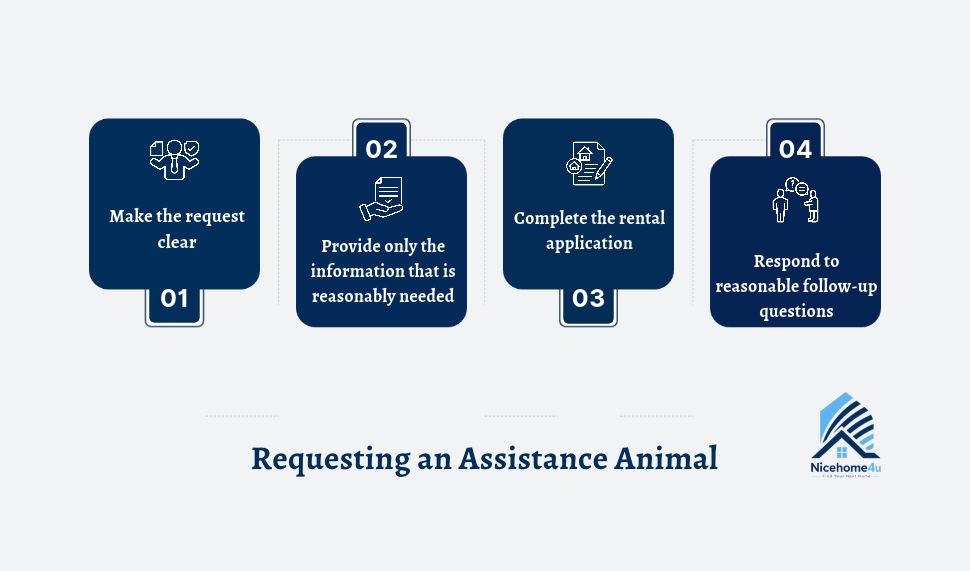
A person does not have to use a particular legal phrase or submit the request on a special form. The request simply needs to make clear that an exception or change is being requested because of a disability-related need.
1. Make the request clear
Tell the housing provider that you are requesting an exception or accommodation because of a disability-related need for an animal. The request may also be made by someone acting on your behalf.
2. Provide only the information that is reasonably needed
If the disability and the disability-related need for the animal are readily apparent or already known, additional disability documentation ordinarily should not be required. If either is not apparent, the housing provider may request reliable information needed to evaluate the request.
3. Complete the rental application
Continue with the regular application and provide the ordinary qualification information requested from applicants. Any request for an accommodation affecting the application process or a qualification policy should also be made clear.
4. Respond to reasonable follow-up questions
The housing provider may need clarification when the disability-related need is not apparent, the information is incomplete, or the request involves an animal not commonly kept in a household. The review should remain focused on what is necessary to decide the accommodation request.
What Documentation May Be Requested?
There is no universal ESA certificate, registration, or identification card that automatically establishes a right to an assistance animal in housing. The appropriate information depends on what is already apparent or known.
For an ADA Service Dog
For an ADA service dog in a public-access setting, when it is not obvious that the dog is a service animal, the permitted inquiry is generally limited to two questions: whether the dog is required because of a disability and what work or task it has been trained to perform. Certification, medical documentation, or a demonstration of the dog’s task cannot be required under the ADA public-access rules.
For Another Assistance or Support Animal
When the disability and the disability-related need for the animal are readily apparent or already known, additional disability documentation generally should not be requested. If either the disability or the disability-related need is not readily apparent or already known, only reliable information necessary to establish the disability, describe the requested accommodation, and show the relationship between the disability and the need for the animal should be requested. Detailed medical records and unnecessary information about the nature or severity of the disability are ordinarily not necessary. Disability-related information should be kept confidential.
A letter, certificate, or registration purchased online does not establish eligibility by itself. Reliable information from a healthcare professional may be considered when the professional has personal knowledge of the person and the disability-related need. Under Oklahoma law, when the disability or disability-related need is not readily apparent, a landlord may request reliable supporting documentation, verify the authenticity of that documentation, and pursue remedies for knowingly false claims or knowingly fraudulent documentation. The source or format of the documentation does not by itself determine whether it is reliable or sufficient.
Animals Not Commonly Kept in Households
HUD guidance distinguishes common household animals from animals not commonly kept in a household. When a person requests an unusual animal, the person may have a more substantial burden of showing a disability-related therapeutic need for that specific animal or type of animal. The request must still be evaluated on its individual facts.
When an Assistance Animal Request May Be Denied?
A request cannot be denied merely because a property has an ordinary no-pet rule or because of assumptions about an animal’s breed, size, or type. A housing provider may deny a request when the legal requirements for an accommodation are not met or when the requested accommodation is not reasonable. Depending on the facts, this may include situations in which:
- The request is not made by or on behalf of a person with a disability.
- There is no disability-related need for the animal.
- The accommodation would impose an undue financial and administrative burden.
- The accommodation would fundamentally alter the nature of the housing provider’s operations.
- The specific animal poses a direct threat to the health or safety of others that cannot be eliminated or sufficiently reduced by another reasonable accommodation.
- The specific animal would cause substantial physical damage to the property of others that cannot be eliminated or sufficiently reduced by another reasonable accommodation.
A direct-threat or property-damage decision must be based on an individualized assessment and reliable, objective evidence concerning the specific animal’s actual conduct or history. It should not be based on speculation, fear, or a stereotype. When appropriate, the housing provider and requester should discuss whether another reasonable accommodation could address the concern.
Public Access Is Different from Housing
Emotional support animals do not have the same automatic public-access rights as ADA service dogs. The ADA generally applies to public accommodations and certain government services, while the Fair Housing Act governs assistance-animal requests in most residential housing. An animal may therefore qualify as an assistance animal at home without having the right to accompany its owner into every store, restaurant, or other public place.
The Bottom Line
Regular pets are governed by ordinary pet requirements, while qualifying service animals and emotional support animals may receive reasonable-accommodation treatment as assistance animals under housing law.
If you are applying for or living in a Nicehome4u rental and need an assistance animal, clearly communicate that you are requesting a disability-related accommodation. For the current submission process, contact the Nicehome4u team.
Sources and Further Information
- U.S. Department of Housing and Urban Development assistance-animal guidance
- U.S. Department of Justice ADA service-animal requirements
- HUD and Department of Justice reasonable-accommodation guidance
- Oklahoma Statutes Title 41 Section 113.2
Last reviewed September 15, 2026. Housing and disability accommodation requirements depend on the circumstances and applicable law. This article provides general information and is not legal advice.