Quick Answer
The 3x rent rule means a landlord generally expects you to earn at least three times the monthly rent in qualifying income. The exact requirement depends on the property’s screening policy.
You might be able to afford the rent but still fall short of the income threshold. Knowing how the property calculates qualifying income can help you avoid applying for a home that does not fit its criteria.
The good news is that falling short of the 3x rent rule doesn’t always end your options. Here’s how to calculate the requirement and understand the alternatives available to renters who don’t qualify on income alone.
How to Calculate 3x the Rent
To calculate the 3x rent rule, multiply the monthly rent by three to find the required monthly income.
Formula:
Monthly rent × 3 = Required monthly income
Example: If a home rents for $1,400 per month, the 3x rent rule sets a monthly income target of $4,200 (1,400 × 3).
Why Do Landlords Use the 3x Rent Rule?
Landlords use the 3x rent rule as a quick way to assess whether an applicant’s income is sufficient relative to the monthly rent. It gives them a consistent starting point for screening applications without relying on rent alone to judge affordability.
However, the calculation doesn’t show a renter’s full financial situation. Two applicants with the same income may have different debts, savings, and monthly expenses. The 3x rent rule is therefore one screening measure, not a complete picture of someone’s ability to manage housing costs.
Is the 3x Rent Rule Based on Gross or Net Income?
The 3x rent rule can be based on gross income (earnings before taxes and deductions) or net income (take-home pay), depending on the property’s screening policy. Because gross income is usually higher, the calculation method can affect whether you qualify.
Nicehome4u uses combined monthly take-home income to assess its standard 3x rent requirement. This means the property’s criteria focus on the income your household receives after taxes and deductions, rather than gross earnings before those deductions.
Before applying, confirm whether the property uses gross or net income and how it calculates the amount that qualifies.
What Types of Income Count Toward the 3x Rent Rule?
The types of income that count toward the 3x rent rule depend on the property’s screening criteria. NiceHome4U considers verifiable income from several sources, including:
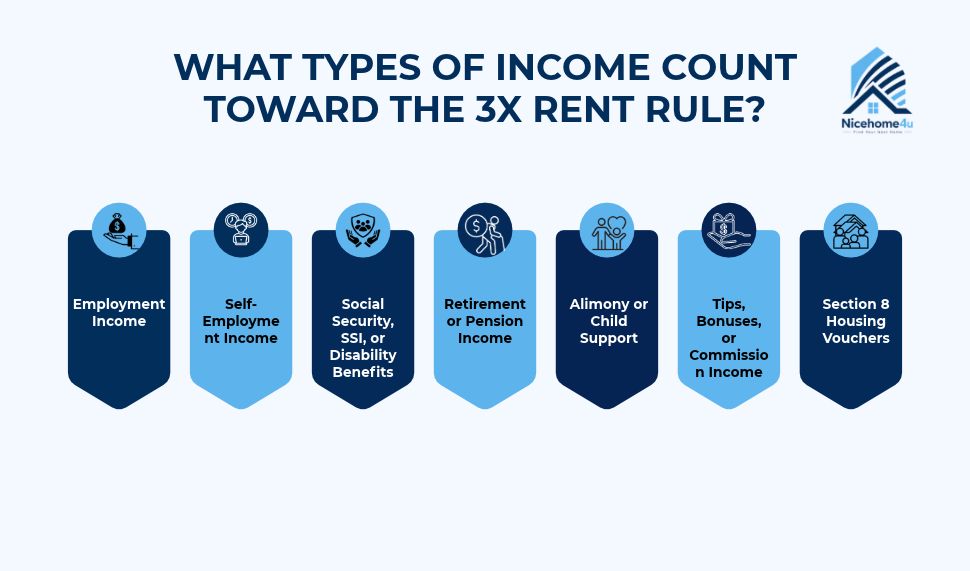
- Employment Income: Full-time or part-time wages, as well as new employment supported by an offer letter.
- Self-Employment Income: Earnings verified through CPA-prepared financials and tax returns.
- Social Security, SSI, or Disability Benefits: Benefits supported by the required award letters.
- Retirement or Pension Income: Income received through retirement or pension payments.
- Alimony or Child Support: Payments supported by court documentation.
- Tips, Bonuses, or Commission Income: Variable earnings verified with three months of bank statements.
- Section 8 Housing Vouchers: Accepted when the property owner agrees to participate in the Section 8 housing program.
Nicehome4u requires qualifying household income to equal at least three times the monthly rent in combined take-home income. However, each income source must meet the property’s verification requirements. Check the property’s criteria to understand which documents you need to provide before applying.
What If You Do Not Meet the 3x Rent Rule?
If your income falls below the 3x rent requirement, ask the landlord whether the property offers other ways to qualify. Consider these options:
- Combine qualifying income: If you plan to live with a partner or roommate, ask whether the property allows applicants to combine their incomes to meet the requirement.
- Apply with a co-applicant: Another qualified applicant may help you meet the household income threshold. Learn more in our guide to how to apply for a rental.
- Ask about a co-signer or guarantor: Depending on the agreement, a co-signer or guarantor may take on financial or other obligations if you fail to meet your lease obligations. Review the differences between a guarantor and a co-signer before asking about this option.
- Ask how variable income is assessed: If you’re self-employed or earn irregular income, the property may consider documented earnings from sources such as contract work or commissions. Our guide on qualifying for a rental when self-employed explains how self-employed renters can prepare.
- Consider a lower-priced rental: Compare homes with lower monthly rent to see whether you can meet their income requirements while keeping your housing costs manageable.
Before paying an application fee, confirm which options the property accepts. These alternatives may help, but the landlord will still assess your application against the property’s requirements.
Is the 3x Rent Rule a Legal Requirement?
The 3x rent rule is generally a landlord’s income-screening policy, not a universal law that requires every renter to earn three times the monthly rent. Landlords may set income criteria, subject to applicable laws and program requirements.
Can landlords require you to make three times the rent? Generally, they may use income-screening criteria, but they must comply with applicable fair housing laws. In Oklahoma, state law prohibits certain discriminatory housing practices. These include refusing to consider the income of joint applicants because of a protected characteristic, or refusing on that basis to recognize verifiable public assistance, court-awarded alimony or child support as a valid income source. This does not mean every landlord must accept every income source in every situation.
If a landlord rejects your application because you don’t meet the threshold, you can ask for the property’s written screening criteria. If you believe the landlord applied those criteria in a discriminatory way, consider contacting a qualified housing attorney or fair housing agency.
What Should Oklahoma Renters Know About the 3x Rent Rule?
For Oklahoma renters who use housing assistance, the standard 3x rent calculation may not tell the whole story. Housing Choice Voucher (Section 8) participants have a separate process for determining their share of the rent.
Under HUD’s Housing Choice Voucher program, a local public housing agency reviews the household’s circumstances, the proposed rent, and applicable utility costs when determining assistance. The property must also participate in the program and meet its requirements. Ask your housing agency how the program applies to your situation before deciding whether a home fits your budget.
For renters who don’t use housing assistance, the property’s written income policy remains the key starting point. Confirm how the landlord calculates qualifying income before submitting an application.
Conclusion
The 3x rent rule gives you a starting point for estimating the income a landlord may require. Calculate three times the monthly rent, then confirm how the property assesses qualifying income before applying.
If you’re considering a home in the Oklahoma City area and need help understanding its income requirements, contact Nicehome4u to discuss the property’s criteria and your next steps.