

Can you and another adult apply for a rental home together and use both incomes to qualify? In many cases, yes.
A simple way to think about a co-applicant is this: another person applies for the same rental with you and completes the required application process.
The most important point is simple: combined income does not always mean combined screening. A landlord or property manager may consider household income together while still reviewing each applicant’s information separately.
Quick Answer: Can Multiple Adults Apply Together?
Yes. Multiple adults can apply for the same rental home.
Depending on the rental criteria, applicants may be able to combine qualifying income to meet an income requirement. Each adult may still need to complete an application, provide income documents, and go through tenant screening.
Understanding this before your apartment search can help you prepare the right documents and avoid making assumptions about how household income will be reviewed.
So, applying together may help with an income requirement, but approval still depends on the property’s full screening criteria.
What Is a Co-Applicant in an Apartment?
On a rental application, the important distinction is that a co-applicant is not simply a financial backup. Their own information may be reviewed as part of the rental application.
For example, you and a roommate find a two-bedroom rental in Oklahoma City. You both plan to live there and split the housing costs.
Your roommate’s income may be counted with yours if the property’s criteria allow combined income. However, your roommate may also need to provide identification, proof of income, rental history, and other screening information.
Who Can Be a Co-Applicant?
A partner, spouse, roommate, sibling, or another adult applying to rent with you may be a co-applicant, depending on the property’s criteria.
Someone who will not live in the rental may fit a co-signer or guarantor role instead. Check the application requirements before choosing the applicant type.
Can Co-Applicants Combine Income to Qualify for an Apartment in Oklahoma City?
Yes, when the rental criteria allow combined household income.
Imagine the rent is $1,200 per month and the property uses a 3× monthly-rent income benchmark. The household would need $3,600 in qualifying monthly income.
- Applicant A earns $2,200 per month.
- Applicant B earns $1,600 per month.
- Combined monthly income is $3,800.
Applicant A does not reach the example benchmark alone. Together, the joint applicants do. This is why applying together can help when one adult has stable income but does not meet an income benchmark alone.
I recommend checking the property’s current rental criteria before paying an application fee. Income calculations and accepted documents can differ by housing provider.
How to Apply With a Co-Applicant
The application process can feel confusing when two or three adults are moving together. Here is a simple four-step breakdown.

1. Each Adult Completes the Required Application
A joint applicant usually provides their own application information.
The landlord or property manager may use that information to identify adult residents and review each required applicant.
2. Applicants Provide Proof of Income
Depending on the property’s criteria, proof of income may include pay stubs, tax returns, bank statements, or other verifiable income records.
I recommend preparing these documents before you start. Missing or inconsistent information can slow the review. For a full application walkthrough, see how to apply for a rental in OKC.
3. Qualifying Income May Be Combined
When combined income is allowed, the housing provider may review qualifying income from multiple applicants as household income.
However, income is only one part of screening. Rental history, credit-related information, identity, and income verification may also be reviewed.
4. Approved Applicants Review the Lease
If approved, read the rental agreement before signing.
Pay close attention to rent responsibility, property damage, lease violations, occupants, early move-out, and the process for adding or removing a leaseholder.
Primary Applicant Meaning vs. Co-Applicant
The phrase “primary applicant” causes more confusion than it should.
A primary applicant may simply be the first or main person connected with the application record. A co-applicant is another person applying for the same rental.
| Role | Application Role | Income May Be Considered? | May Sign Lease? |
| Primary applicant | Main or first applicant on the application record | Yes | Yes |
| Co-applicant | Applies for the same rental with another applicant | Yes | Usually, if approved as a leaseholder |
The labels can vary by application system. The rental criteria and signed lease matter more than the title “primary.”
Co-Applicant vs. Co-Signer vs. Occupant vs. Guarantor: What’s the Difference?
These four roles can appear during the rental process, but they do not mean the same thing. The biggest differences are who plans to live in the rental, who applies, and who may have financial responsibility under the agreement.
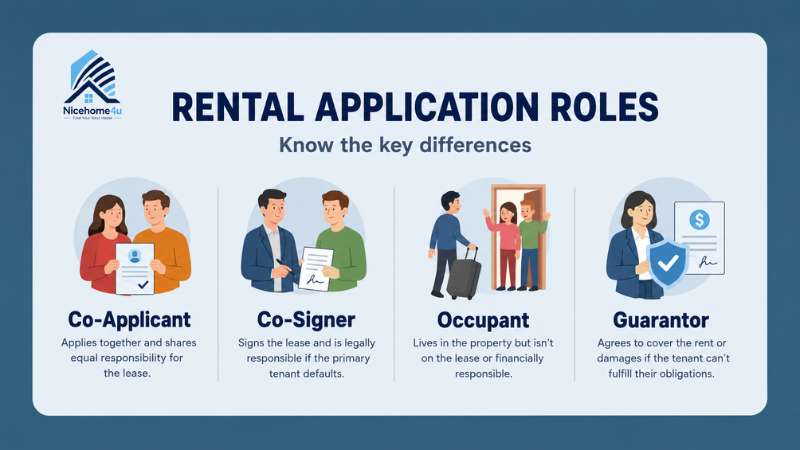
| Role | Usually Lives in the Rental? | Provides Application or Financial Information? | Main Role |
| Co-applicant | Usually yes | Yes | Applies as another renter and may sign the lease |
| Co-signer | Usually no | May complete financial screening | Supports the rental obligation |
| Occupant | Yes | Depends on property requirements | Is approved to live in the rental |
| Guarantor | Usually no | May provide income and credit information | Provides financial backing for the renter |
Co-Applicant
A co-applicant applies for the rental with you as another renter.
A roommate is not automatically a co-applicant. “Roommate” describes someone you live with, while “co-applicant” describes the person’s role during the rental application process.
For example, if you and a roommate apply together for an Oklahoma City apartment, you may both be co-applicants during the application process.
Co-Signer
A co-signer may help an applicant who needs additional financial support to qualify. They usually do not live in the rental but may take on financial responsibility under the signed agreement.
A parent, for example, may co-sign for a renter with limited income or rental history. The co-signer’s income, credit, or other financial information may be reviewed.
The exact responsibility depends on the lease or co-signer agreement.
Occupant
An occupant is approved to live in the rental but may not have the same lease role or responsibilities as a leaseholder.
A roommate who applies and signs the lease may be a co-applicant or co-tenant. Someone listed only as an occupant may have a different role under the rental agreement. Our tenant vs. occupant guide explains these lease and responsibility differences in more detail.
Adult occupants may still need to complete application or screening requirements, depending on the property.
Guarantor
A guarantor provides financial backing for a renter who may not qualify alone and usually does not live in the apartment.
Depending on the agreement, the guarantor may become financially responsible if the renter fails to meet covered payment obligations.
Before applying, check which role the landlord or property manager accepts and what application, screening, or financial documents that person must provide. If you are unsure which financial support role fits your situation, compare a guarantor vs. co-signer on a lease before applying.
What Is a Co-Applicant on a Lease?
So, what is a co-applicant on a lease after the application is approved?
The important difference is that co-applicant describes the person’s role during the application process. If that person signs the rental agreement, they become a tenant, leaseholder, or co-tenant under the lease.
At that point, their responsibilities come from the signed lease and applicable Oklahoma tenant laws.
Paying Rent and Following the Lease
A co-tenant must follow the rent and lease terms they agreed to. This can include paying rent on time, following occupancy rules, and complying with other valid property requirements.
A private agreement between roommates to split rent 50/50 does not automatically change the obligations in the signed lease. Depending on the lease terms, one co-tenant may still be responsible for the required rent if the other person does not pay their share.
Caring for the Rental Property
Co-tenants must also follow the lease and applicable tenant responsibilities for caring for the rental. This generally includes keeping the property reasonably clean and avoiding deliberate or negligent damage.
Following Property Rules and Respecting Other Residents
After signing the lease, each co-tenant must follow applicable property and occupancy rules. A co-tenant should also understand any lease terms related to guests, household members, and conduct at the rental.
Moving Out Does Not Automatically End Lease Responsibility
If one co-tenant moves out, their lease obligations do not automatically disappear simply because they no longer live in the rental.
The lease terms and any approved lease change determine whether a person is released from the agreement. Under Oklahoma law, a tenant who wrongfully abandons a rental during the lease term may remain responsible for rent or a rental difference after the landlord makes reasonable efforts to rerent, depending on the circumstances. Learn more about what can happen when you break a lease early in Oklahoma.
The main point is simple: once a co-applicant signs the lease, they should understand that they are more than an extra income source. They may have rent, property-care, and lease responsibilities as a tenant under the agreement.
Can a Co-Applicant Help If I Don’t Qualify Alone?
A co-applicant may be most helpful when income is the main reason you do not qualify alone. However, applying together may not resolve a credit, rental history, eviction record, or income verification issue because each applicant may still be screened separately.
For example, you and a partner may meet the income requirement together, but a separate screening issue may still affect approval. If credit is the concern, our guide to renting with bad credit in Oklahoma explains the other factors landlords may review.
A co-applicant may strengthen an application, but does not guarantee approval.
What Oklahoma City Renters Should Know About Application Rules
First, separate rental criteria from law. A rule such as earning three times the monthly rent is a screening criterion used by some housing providers. It should not automatically be described as an Oklahoma City law.
Rental screening must also comply with applicable fair housing law. The federal Fair Housing Act prohibits housing discrimination because of race, color, national origin, religion, sex, familial status, or disability.
Oklahoma’s Attorney General provides a process for housing discrimination complaints, and the Oklahoma City Human Rights Commission is authorized to receive unlawful housing discrimination complaints within Oklahoma City.
My advice is to review the written rental criteria and provide accurate, consistent information for every applicant. If you are unsure whether income will be combined, ask before applying.
Ready to apply with a partner, roommate, or family member? Browse NiceHome4U’s available Oklahoma City rentals and check each property’s rental criteria before you start your application.
4 Things to Discuss Before Applying With a Co-Applicant
A joint application is easier when both adults understand the financial and lease expectations.
1. Can We Afford the Rent as a Household?
Do not stop at “we meet the income requirement.” Look at rent, utilities, and regular monthly expenses.
2. How Will We Handle the Rent Payment?
Decide who will pay, whether the payment system allows split payments, and how each person will transfer their share.
3. Is There an Application Issue We Should Discuss?
A serious rental history, income verification, or credit issue may affect the application. Discuss any known concerns before screening so both applicants understand what may affect the application.
4. What If One Person Wants to Move Out?
Do not assume a lease signer can simply remove their name. Check the lease-change process and ask what approval or documentation would be required.
How to Prepare a Strong Multiple-Applicant Rental Application
Before applying, I recommend having each adult prepare:
- Government-issued identification
- Current contact information
- Recent proof of income
- Employment or income details
- Current and previous landlord information
- Any other documents requested under the rental criteria
Make sure every applicant completes the required steps promptly. One unfinished application can delay review of the household.
Also check names, addresses, and income details for accuracy before submitting. Clear, consistent information makes verification easier.
What If My Rental Application Is Denied After Applying Together?
If a tenant screening report affected the rental decision, the landlord must inform you that the report played a role.
Review the adverse action notice and identify the consumer reporting company. You have the right to request a free copy of the report from the screening company within 60 days of the notice and dispute inaccurate information.
Do not assume combined income caused the denial. Credit, rental history, identity, or another screening issue involving either applicant may have affected the decision.
Final Thoughts: Applying Together Can Help, but Each Adult Still Applies
So, what is the biggest thing I want you to remember about co-applicants?
You can apply together and may be able to combine income, but each adult can still be reviewed as an applicant.
A partner, roommate, or family member may help the household meet an income requirement, but each person has a separate role during the application and, if added as a leaseholder, responsibilities under the lease.
You are applying for a home together. Prepare each person’s documents and make sure you understand the lease responsibilities connected with each applicant.