Finding a rental home can feel a little different when you’re self-employed. You may have a solid rental history, good credit, and the ability to comfortably afford a home, but the application process can still raise questions because your work and finances don’t look like those of a traditional employee.
That doesn’t mean you’re a less qualified renter. Whether you’re a freelancer, contractor, business owner, or independent professional, the key is knowing what landlords typically look for and being prepared to present your application clearly. From organizing your paperwork and rental history to understanding credit requirements and communicating with the landlord, a little preparation can make the process much easier.
In this guide, we’ll walk through practical steps self-employed renters can take to successfully qualify for a rental home and put together a stronger application.
Key Takeaways
- Self-employed renters can qualify by showing reliable income and meeting the landlord’s screening requirements.
- Income verification is especially important when you don’t have traditional pay stubs or W-2 forms.
- Tax returns, 1099s, bank statements, profit and loss statements, and invoices can help demonstrate your income.
- Credit history, rental history, and overall financial stability also influence a rental application.
- Preparing documents before applying can reduce delays during tenant screening.
- Explaining income fluctuations and responding quickly to landlord questions can strengthen your application.
- If you’re denied, find out why and address the issue before applying for another rental home.
Can You Rent a House If You’re Self-Employed?
Yes, self-employed renters can qualify for a rental home. Landlords and property managers usually care less about how you earn your money and more about whether you can pay the rent consistently. The key is showing reliable income and meeting the landlord’s screening requirements.
Self-employed applicants may go through a little more income verification because they don’t always have regular pay stubs or W-2 forms. Instead, landlords may review tax returns, 1099 forms, business bank statements, or profit and loss statements to understand your income. Submitting a complete rental application can also help avoid delays during screening.
They’ll also look at a few other things before making a decision:
- Consistent income: Does your income show that you can afford the rent?
- Credit history: Have you handled your financial obligations responsibly?
- Rental history: Do you have a record of paying rent and following lease terms?
- Financial stability: Do your savings or other resources support your ability to pay?
So, being self-employed isn’t the problem. Showing that you can reliably meet the rental requirements is what matters. Having your financial documents ready can make the screening process much smoother, especially when you’re applying for a rental home in Oklahoma City.
What Landlords Look for in a Self-Employed Rental Application
When landlords review a self-employed applicant, they don’t focus only on your job title. They’re looking for signs that you’ll be a reliable tenant who can pay rent on time and take care of the property.
Here’s what most landlords and property managers evaluate during the rental application process:
1. Consistent income
Landlords understand that self-employed income isn’t always the same every month. Instead of expecting identical earnings, they look for a consistent income pattern that shows you can comfortably afford the rent.
2. Credit history
A credit check helps landlords understand how you’ve managed your financial obligations. While a perfect credit score isn’t always required, paying bills on time and keeping debt under control can strengthen your application.
3. Rental history
Your rental history tells landlords how you’ve treated previous rental homes. Positive references, on-time rent payments, and a history of following lease terms can make a strong impression.
4. Financial stability
Landlords also consider your overall financial picture. Savings, business income, and other financial resources can help demonstrate that you’re prepared to handle rent, even if your monthly income varies.
The good news? Most of these factors are things you can prepare before you submit your application. Next, let’s look at the documents that can help prove your income and give landlords the confidence to approve your rental application.
How to Show Proof of Income as a Self-Employed Renter
When you don’t have regular pay stubs, proof of income becomes the most important part of your rental application. The goal isn’t to provide every financial document you own. It’s to give landlords enough information to verify that your income is stable and that you can comfortably afford the rent.
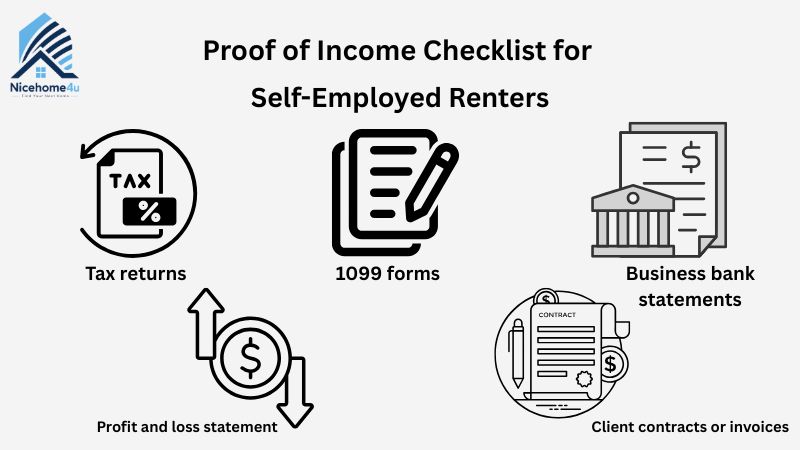
Here are the documents that can strengthen your application:
Tax returns
Tax returns give landlords a snapshot of your income over time. Many property managers ask for the last one or two years of tax returns because they show a more complete financial picture than a single month’s earnings.
1099 forms
If you work as a freelancer or independent contractor, 1099 forms help verify income from your clients. They can support your tax returns and demonstrate a consistent source of earnings.
Business bank statements
Business bank statements show money flowing into your account. They can reassure landlords that your business generates regular income, even if your monthly earnings fluctuate.
Profit and loss statement
A current profit and loss statement helps explain your business’s financial performance. If your tax return doesn’t reflect your current income, this document can provide additional context.
Client contracts or invoices
Signed contracts and paid invoices can demonstrate ongoing work and future income. They are especially helpful for self-employed applicants with long-term clients or project-based work.
Self-Employed Rental Document Checklist
Before submitting your rental application, make sure you have:
- Recent tax returns
- 1099 forms (if applicable)
- Business bank statements
- Profit and loss statement
- Client contracts or paid invoices
- Government-issued photo ID
A well-organized application can make a big difference. The easier it is for a landlord or property manager to verify your income, the smoother the approval process is likely to be.
Now that you know which documents to prepare, what else can you do to stand out from other applicants? Let’s look at practical rental tips that can improve your chances of getting approved.
7 Rental Tips to Improve Your Chances of Approval
Having the right documents is a great start, but they’re only part of the approval process. One thing property managers often notice is that two applicants with similar incomes can receive different outcomes because one presents a stronger, more complete rental application. The good news? Most of these factors are within your control.
1. Prepare your documents before you apply
One thing property managers often notice is that incomplete applications take longer to review. Before you apply, gather your tax returns, 1099 forms, business bank statements, and other proof of income in one place. This makes income verification easier and helps prevent unnecessary follow-up requests.
2. Choose a rental home that fits your budget
From a property manager’s perspective, affordability is just as important as income. Choosing a rental home that fits your budget shows landlords you can comfortably manage the monthly rent.
3. Review your credit report before applying
Here’s something many renters overlook. Landlords often review more than just your credit score during a credit check. They may also look for missed payments, outstanding debts, or other financial concerns. Checking your credit report in advance gives you time to correct errors or explain past issues before they become questions during tenant screening. You can request a free copy of your credit report each year through AnnualCreditReport.
4. Highlight a positive rental history
Many landlords place just as much value on a positive rental history as they do on income verification. If you’ve been a reliable tenant, include references from past landlords whenever possible.
5. Explain income fluctuations before you’re asked
If you’re a freelancer, independent contractor, or business owner, it’s normal for your income to vary throughout the year. A brief explanation, along with supporting documents, helps landlords understand your financial picture and reduces unnecessary questions during the review process.
6. Ask about alternative approval options
Don’t assume your application will be denied if you don’t meet every requirement. Some landlords may approve a qualified applicant with conditions, such as a larger security deposit or a co-signer, depending on their rental policies. Asking about available options shows that you’re serious about finding a solution.
7. Respond quickly during tenant screening
After submitting your rental application, keep an eye on your phone and email. It’s common for landlords to ask follow-up questions before making a final decision, so responding promptly helps keep your application moving.
Here’s the bottom line: landlords aren’t looking for the perfect applicant. They’re looking for someone who can consistently meet their lease obligations and communicate throughout the rental process. A well-organized application, reliable proof of income, and a positive rental history can go a long way toward getting approved.
But even strong applications can run into problems. So, what are the biggest mistakes self-employed renters make, and how can you avoid them? Let’s look at the most common pitfalls next.
Common Mistakes Self-Employed Renters Should Avoid
Even a well-prepared rental application can run into problems if you overlook a few important details. The good news? Most of these mistakes are easy to avoid once you know what landlords are looking for during the tenant screening process.
Here are some of the most common mistakes self-employed renters make:
- Submitting incomplete income documents. Missing tax returns, bank statements, or other proof of income can delay the income verification process and leave landlords with unanswered questions.
- Waiting to explain irregular income. If your income changes throughout the year, don’t wait for a landlord to ask about it. A brief explanation with supporting documents often provides the context they need.
- Ignoring your credit report. Small errors on a credit report can sometimes affect a rental application. Reviewing your credit before you apply gives you a chance to fix mistakes or prepare an explanation if needed.
- Applying before you’re ready. One thing property managers often notice is that rushed applications are more likely to be missing important information. Taking a little extra time to organize your documents can make the review process much smoother.
- Applying for homes outside your budget. Choosing a rental home that comfortably fits your income demonstrates financial responsibility and improves your chances of approval.
So, what should you do if your application is still denied? Understanding the reason behind the decision can help you prepare a much stronger application the next time you rent a house.
What If Your Rental Application Is Denied?
A denied rental application doesn’t always mean you won’t qualify for another home. In many cases, it simply means there’s something in your application that needs to be strengthened. Understanding why you were denied is the first step toward improving your chances the next time you apply.
Start by finding out why
Before applying elsewhere, ask the landlord or property manager if they can explain the reason for the decision. While they may not always be able to share every detail, knowing whether the issue was related to income verification, credit history, rental history, or another screening requirement helps you focus on what to improve.
Strengthen your next application
Here’s where preparation pays off. Property managers often see applicants succeed on a second application because they took time to address the concerns from the first one. Before you apply again, consider taking these steps:
- Update your proof of income with the most recent financial documents.
- Review your credit report and correct any errors.
- Include additional rental references if they’re available.
- Add a brief explanation for irregular income or recent financial changes.
- Ask whether a co-signer or additional security deposit is an option.
Keep moving forward. Many self-employed renters are approved after making a few adjustments to their application. The key is showing landlords that you can meet their rental requirements and comfortably afford the home.
Now that you know how to qualify for a rental home as a self-employed renter, let’s recap the most important steps before you start your next application.
Conclusion
Being self-employed doesn’t have to stand in the way of renting a home. While landlords may ask for additional proof of income, they’re ultimately looking for applicants who can demonstrate financial stability, a positive rental history, and a complete rental application. The good news? A little preparation today can help you avoid delays and approach the application process with confidence.
At Nicehome4u, we understand that every renter’s financial situation is different. Whether you’re a freelancer, independent contractor, or small business owner, our goal is to make the rental process as straightforward as possible. When you’re ready to take the next step, browse our available rental homes in the OKC metro to find a home that fits your lifestyle and budget. If you have questions about qualifying or preparing your application, contact our team. We’re here to help you move forward with confidence.