What Is Section 8 Housing?
If you’re struggling to afford a safe place to live in Oklahoma, you’ve probably heard about “Section 8.” Officially called the Housing Choice Voucher Program, it’s the nation’s largest rental assistance program. Think of it as a government subsidy that helps cover a portion of your rent so you can live in decent housing you’d otherwise struggle to afford.
Here in Oklahoma, the program is primarily run by the Oklahoma Housing Finance Agency (OHFA), along with around 105 local Public Housing Authorities across the state. In 2022 alone, OHFA distributed roughly $59.8 million in federal funds to help about 25,250 residents, so this is a lifeline for thousands of Oklahomans.
Types of Section 8 Vouchers
When people talk about Section 8, they’re often referring to different program types. Here’s a breakdown of the four main types of rental assistance you might encounter in Oklahoma:
1. Tenant-Based Housing Choice Voucher (HCV)
This is what most folks mean by “Section 8.” It’s the standard voucher that stays with you, not the property . Here’s how it works: you find your own rental, whether it’s an apartment, house, duplex, or even a mobile home, and the voucher follows you. As long as the landlord agrees to participate and the unit meets safety standards, you can use your voucher there. This gives you freedom to choose where you live .
2. HCV Homeownership Program
Did you know you can use a Section 8 voucher to buy a home? The HCV Homeownership program allows families already in the HCV program to use their voucher toward homeownership expenses . To qualify, you must meet specific income and employment requirements (though elderly and disabled families are exempt from the employment requirement), be a first-time homeowner, and complete pre-assistance homeownership counseling . This is a lesser-known but powerful option for long-term stability.
3. Project-Based Voucher (PBV)
These vouchers are tied to specific units, not the family . If you get a project-based voucher, you must live in that particular property, you can’t take it elsewhere. PHAs can use some of their HCV funding for contracts that tie the assistance to a specific building, meaning that when a resident moves out, the housing assistance stays with that unit . In Oklahoma, OHFA contracts with about 180 properties through a program called Performance Based Contract Administration, providing over 12,500 rental units.
4. Project-Based Rental Assistance (PBRA)
Like PBV, PBRA is also tied to specific units in a building . The key difference is that PBRA is administered by HUD’s Office of Multifamily Housing, while PBV is part of the HCV program run by Public Housing Authorities . Both PBV and PBRA are often used in the Rental Assistance Demonstration (RAD) program, which helps convert public housing to long-term Section 8 assistance contracts . Under RAD, a PHA may choose between PBV or PBRA contracts .
Here’s a quick comparison:
|
Voucher Type |
Tied To |
Administered By |
Portability |
|
Tenant-Based HCV |
Family |
PHA/OHFA |
Yes, can move with you |
|
HCV Homeownership |
Family |
PHA/OHFA |
Used for home purchase |
|
Project-Based Voucher (PBV) |
Property/Unit |
PHA/OHFA |
No, stays with the unit |
|
Project-Based Rental Assistance (PBRA) |
Property/Unit |
HUD Multifamily |
No, stays with the unit |
How Does Section 8 Work? A Step-by-Step Breakdown
Understanding the process makes it less intimidating. Here’s what happens:
- Apply and Get on the Waiting List
You submit an application to OHFA or your local housing authority. But here’s the catch, demand is huge. In Oklahoma, over 26,000 people were waiting for rental assistance as of 2022, and the average wait time was 18 months. Some waiting lists are currently closed, so you need to watch for reopening announcements. - Wait for Your Turn
When you reach the top of the list, OHFA schedules an appointment. They’ll review your household composition, income, and verify everything. This meeting doesn’t guarantee you’ll get a voucher, but it’s the next crucial step. OHFA prioritizes people who are homeless or have disabilities, moving them to the front of the line. - Get Your Voucher
Once eligibility is confirmed and funding is available, you receive your voucher. OHFA determines your bedroom size based on household size. Here’s a quick look at how that works:
|
Voucher Size |
Persons in Household |
|
0 Bedroom |
1-2 persons |
|
1 Bedroom |
1-4 persons |
|
2 Bedrooms |
2-6 persons |
|
3 Bedrooms |
3-8 persons |
|
4 Bedrooms |
4-10 persons |
- Find a Place to Live
You have 60 days to find a suitable rental. The landlord must agree to participate, and the unit must pass a Housing Quality Standards (HQS) inspection . You can request an extension if needed, but OHFA might not grant one. - Sign Leases and Move In
Once the unit passes inspection and rent is considered reasonable, OHFA signs a contract with the landlord. You’ll also sign your lease. OHFA pays the landlord directly, and you pay your portion, typically about 30% of your adjusted monthly income . OHFA won’t authorize a contract requiring you to pay more than 40% of your monthly adjusted income in rent. - Maintain Your Voucher
You must keep your contact information updated and report any changes in income or household size . If OHFA can’t reach you, you could be removed from the waiting list.
Eligibility Requirements for Oklahoma Section 8
So, who qualifies for Section 8 in Oklahoma?
Income Limits
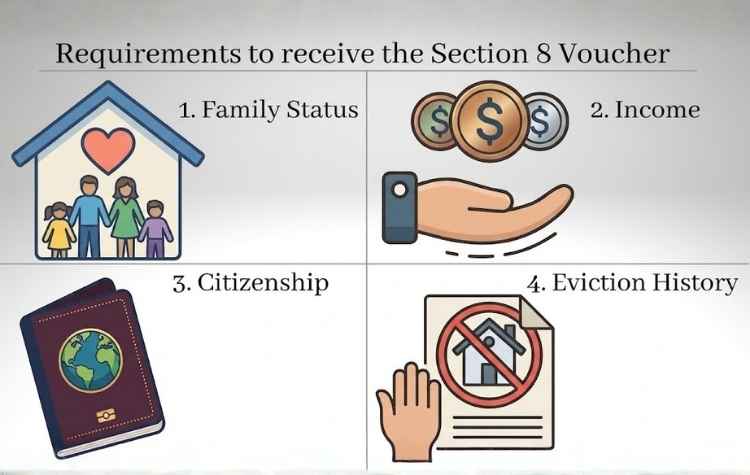
This is the biggest factor. Your household income must be low, generally 50% or less of the Area Median Income (AMI) for your county. Here’s what income limits look like for various Oklahoma counties (FY 2025 numbers):
|
County |
Household Size |
Very Low Income (50% AMI) |
|
Pittsburg County |
1 person |
$26,450 |
|
Pittsburg County |
4 persons |
$37,750 |
|
Pottawatomie County |
1 person |
$29,450 |
|
Pottawatomie County |
4 persons |
$42,050 |
|
Washington County |
1 person |
$30,850 |
|
Washington County |
4 persons |
$44,050 |
Note: These are official HUD numbers, but limits vary by county and household size. Check the HUD website for your specific county.
Most housing authorities require 75% of new voucher recipients to have “extremely low income”, meaning below the federal poverty level or 30% of AMI, whichever is higher.
Citizenship and Immigration Status
You must be a U.S. citizen or have eligible immigration status. All household members need to provide documentation, such as the Declaration of Section 214 Status form .
Background Checks
You cannot be a lifetime registered sex offender or live with one. Drug or violent crime convictions within the last three years may disqualify you. You also can’t owe money to any housing authority .
Other Requirements
You should be at least 18 years old or legally emancipated. Your landlord’s reference can matter, especially when you start looking for a place.
Ready to Find Your Section 8 Home in Oklahoma?
Now that you understand how the Section 8 program works and what it takes to qualify, you might be wondering, what’s next?
If you already have a Section 8 voucher in hand, the hardest part is often finding a landlord who accepts it. That’s where NiceHome4U comes in. We specialize in helping Oklahoma residents with Section 8 vouchers find quality, affordable rental homes that meet program requirements. Whether you’re looking for a cozy apartment in Oklahoma City, a family home in Tulsa, or a quiet duplex in one of our smaller communities, we have Section 8-friendly properties ready for you.
Don’t let your voucher go to waste, contact us today and let our team help you find your next Section 8 home in Oklahoma.
👉 Browse Our Section 8 Rentals or Contact NiceHome4U Now